York Press, a long-established UK educational publisher with strong international reach, has selected Avallain Magnet to support the digital delivery of its educational programmes. The partnership strengthens York Press’s work with Ministries of Education, schools and institutional partners worldwide while enabling the publisher to extend its programmes internationally through scalable, high-quality digital learning delivery.
York Press Selects Avallain Magnet and Avallain Author to Support International Programme Delivery
St. Gallen, January 2026 – York Press has entered into a partnership with Avallain to use Avallain Magnet, our peerless and AI-integrated learning management system, as the digital learning platform for delivering its educational programmes across international markets.
A Publisher with Deep Roots and International Reach
Established in 1944, York Press has been active in educational publishing for more than 80 years. Headquartered in the UK, the company operates internationally across the public and private education sectors, with a strong track record of collaborating with institutional partners worldwide.
York Press focuses on the development of learner-centred materials for English Language Teaching and school education, aligning pedagogical quality with local curricula and educational priorities.
The company is also widely recognised for its long-term partnership with Pearson UK through the York Notes revision guides for English Language and Literature.
What Avallain Magnet Enables for Educational Publishers
Avallain Magnet is a powerful, customisable, end-to-end learning management system with AI-integrated technology. It enables publishers and education providers to deliver structured digital educational programmes while retaining control over content, pedagogy and learner experience.
Designed for deployment across institutions, regions and markets, Avallain Magnet provides the flexibility required to support different curricula, learner needs and delivery models. This makes it particularly suitable for international publishers such as York Press, which work with public-sector partners and operate across multiple geographies.
Supporting York Press’ Digital Strategy and Programme Expansion
Through the use of Avallain Magnet, York Press strengthens its ability to deliver programmes digitally to Ministries of Education and other institutional partners worldwide. The platform also supports the publisher’s plans to deliver programmes internationally and consistently across markets beyond any single region.
Avallain Magnet enables York Press to scale digital delivery efficiently while ensuring consistency, accessibility and quality across markets. This allows programmes developed for specific educational contexts to be adapted and delivered reliably in different countries and learning environments.
In addition to Avallain Magnet, York Press is also implementing Avallain Author, our flexible, AI-powered authoring tool. This allows York Press to create publisher-grade learning content at scale, enabling rich interactivity, pedagogical consistency and efficient content production. Content created in Avallain Author is seamlessly delivered through Avallain Magnet, supporting an integrated workflow from content creation to programme delivery.
‘York Press’s partnership with Avallain further enhances its ability to deliver high-quality educational resources and services worldwide by leveraging Avallain’s innovative digital learning platform’, says Habib Sayegh, CEO of York Press.
A Long-Term Collaboration with Strategic Impact
The partnership is the result of several years of discussion and collaboration and represents a significant step in York Press’s digital development. By combining York Press’s publishing expertise, international credibility and institutional relationships with Avallain Magnet’s digital delivery capabilities, the collaboration establishes a strong foundation for sustainable growth and global reach.
About York Press
Founded in 1944, York Press has been at the forefront of international education for over 80 years. As a family-owned and operated company, we take pride in our rich history and our commitment to excellent education. We use our deep understanding of the evolving educational landscape to continue to innovate and adapt to meet the needs of educators and learners worldwide. Our expertise spans both public and private education sectors, offering a comprehensive range of services to Ministries of Education and the private education sector worldwide.
About Avallain
For more than two decades, Avallain has enabled publishers, institutions and educators to create and deliver world-class digital education products and programmes. Our award-winning solutions include Avallain Author, an AI-powered authoring tool, Avallain Magnet, a peerless LMS with integrated AI, and TeacherMatic, a ready-to-use AI toolkit created for and refined by educators.
Our technology meets the highest standards with accessibility and human-centred design at its core. Through Avallain Intelligence, our framework for the responsible use of AI in education, we empower our clients to unlock AI’s full potential, applied ethically and safely. Avallain is ISO/IEC 27001:2022 and SOC 2 Type 2 certified and a participant in the United Nations Global Compact.
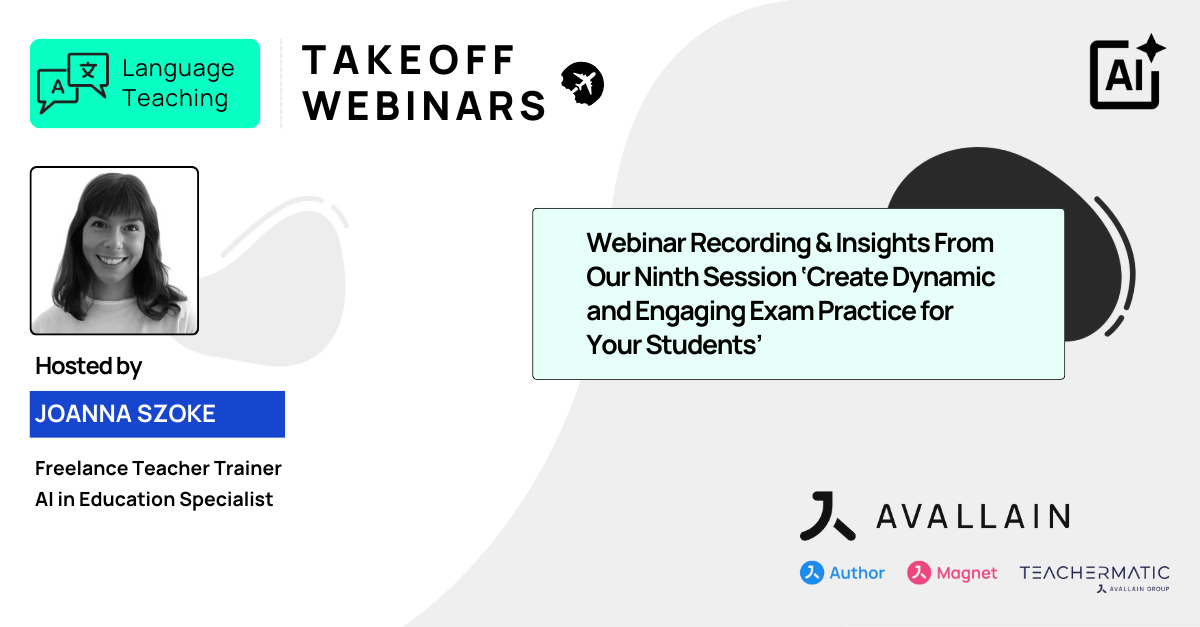
The first Language Teaching Takeoff Webinar of the year welcomed AI in education specialist and freelance teacher trainer Joanna Szoke, who explored how teachers can use the TeacherMatic Language Teaching Edition to create dynamic, engaging exam practice.
Make Exam Preparation More Engaging and Effective
London, January 2026 – In ‘Create Dynamic and Engaging Exam Practice for Your Students’, Joanna discussed assessment and feedback. She demonstrated how teachers can use the ‘Cambridge Style Exam Prep Generator’ and ‘Worksheet’ generator to produce targeted materials for learners preparing for high-pressure assessments.
Moderated by Giada Brisotto, Senior Marketing and Sales Operations Manager at Avallain, the session reinforced the importance of moving beyond assessment as simply a grade, positioning it instead as an opportunity to support learner progress and give teachers clearer insight into what to reinforce and revisit.
Assessment and Feedback
Joanna began by emphasising the close relationship between assessment and feedback, describing them as a continuous cycle rather than separate classroom tasks. When assessment is used as an ongoing process, it becomes a practical way to identify what learners understand, where they need further support and how teachers can adapt to meet those needs.
Rather than treating assessment as an endpoint, Joanna encouraged teachers to use it as a guide to strengthen learner progress and to ensure that feedback remains purposeful and actionable.
Exam English vs Real-Life English
Exam preparation can easily become focused on format and technique, but meaningful practice also needs to develop transferable communication skills. Joanna stressed the importance of connecting exam tasks to real-life language use. By making this connection, teachers ensure that learners can apply what they practise beyond the assessment setting.
Joanna explained how exam-style activities can be adapted to reflect authentic contexts and learner interests, keeping preparation engaging while still targeting the specific demands of the assessment. This approach supports both exam readiness and broader language development without compromising either.
Cambridge-Style Exam Practice in Action
To bring these ideas into a practical teaching context, Joanna demonstrated the ‘Cambridge Style Exam Prep Generator’ and how language educators can use it to create practice tasks aligned with Cambridge English levels A2 Key, B1 Preliminary, B2 First and C1 Advanced. Depending on the level selected, the generator supports different paper formats, including Reading and Writing at A2 Key, Reading at B1 Preliminary and Reading and Use of English at both B2 First and C1 Advanced.
Joanna highlighted how quickly teachers can generate exam-style materials, then refine them to suit their learners and classroom context. Teachers can adjust the topic, language focus or task demands to create more relevant practice and keep preparation adaptable. She also emphasised that these materials are intended solely for practice. Teachers should use them alongside official past papers and published exam preparation resources, with teacher review and adaptation remaining essential.
Flexible Worksheets for Targeted Practice
To build level-appropriate practice materials that can be adapted to different teaching contexts, Joanna also showcased the ‘Worksheet’ generator. Worksheets are a reliable format for reinforcing learning and checking understanding, particularly during assessment preparation.
The demonstration highlighted how teachers can generate worksheets on almost any topic, select activity types and adjust outputs to reflect learner profiles and specific needs. Teachers can also refine results further, remove suggested answers where appropriate and export content into editable formats for layout changes and added visuals. This flexibility makes it easier to create engaging, targeted practice while keeping teacher review and adaptation central.
Supporting Confident Exam Preparation
Effective exam preparation is not only about measuring performance. It is also an opportunity to strengthen learning through purposeful assessment, timely feedback and targeted practice that reflects real assessment demands.
With CEFR alignment built into the TeacherMatic Language Teaching Edition, teachers can generate level-appropriate materials that support structured preparation and classroom needs. By combining tools such as the ‘Cambridge Style Exam Prep Generator’ and the ‘Worksheet’ generator with professional judgement and refinement, teachers can create engaging practice that supports learner confidence and readiness when it matters most.
Explore the TeacherMatic Language Teaching Edition
Built for language teaching, the TeacherMatic Language Teaching Edition enables teachers to create CEFR-aligned materials for exam preparation, assessment, classroom practice and more, with flexibility to refine outputs for different learners and contexts.
🗓 Thursday, 12th February 🕛 12:00 – 12:30 GMT | 13:00 – 13:30 CET
Join award-winning educator Nik Peachey as he demonstrates how to use planning generators in the TeacherMatic Language Teaching Edition. See AI tools such as the ‘Scheme of Work/Curriculum Plan’ generator, which are designed to support teachers, academic managers and directors of studies in reducing repetitive preparation and creating structures that can be adapted to any teaching context.
For more than two decades, Avallain has enabled publishers, institutions and educators to create and deliver world-class digital education products and programmes. Our award-winning solutions include Avallain Author, an AI-powered authoring tool, Avallain Magnet, a peerless LMS with integrated AI, and TeacherMatic, a ready-to-use AI toolkit created for and refined by educators.
Our technology meets the highest standards with accessibility and human-centred design at its core. Through Avallain Intelligence, our framework for the responsible use of AI in education, we empower our clients to unlock AI’s full potential, applied ethically and safely. Avallain is ISO/IEC 27001:2022 and SOC 2 Type 2 certified and a participant in the United Nations Global Compact.
Rapid technological, social and linguistic change is reshaping language education and research. In this piece, Prof John Traxler reflects on Avallain’s collaboration with the TISLID conference series (Technological Innovation for Specialized Linguistic Domains), exploring the limits of traditional, stable frameworks and considering why more adaptive, responsive models are increasingly necessary. This article also highlights the importance of sustained dialogue between researchers and education technology developers in translating research into practice.
Language Education and Technology in Times of Rapid Change: Ahead of the TISLID Conference
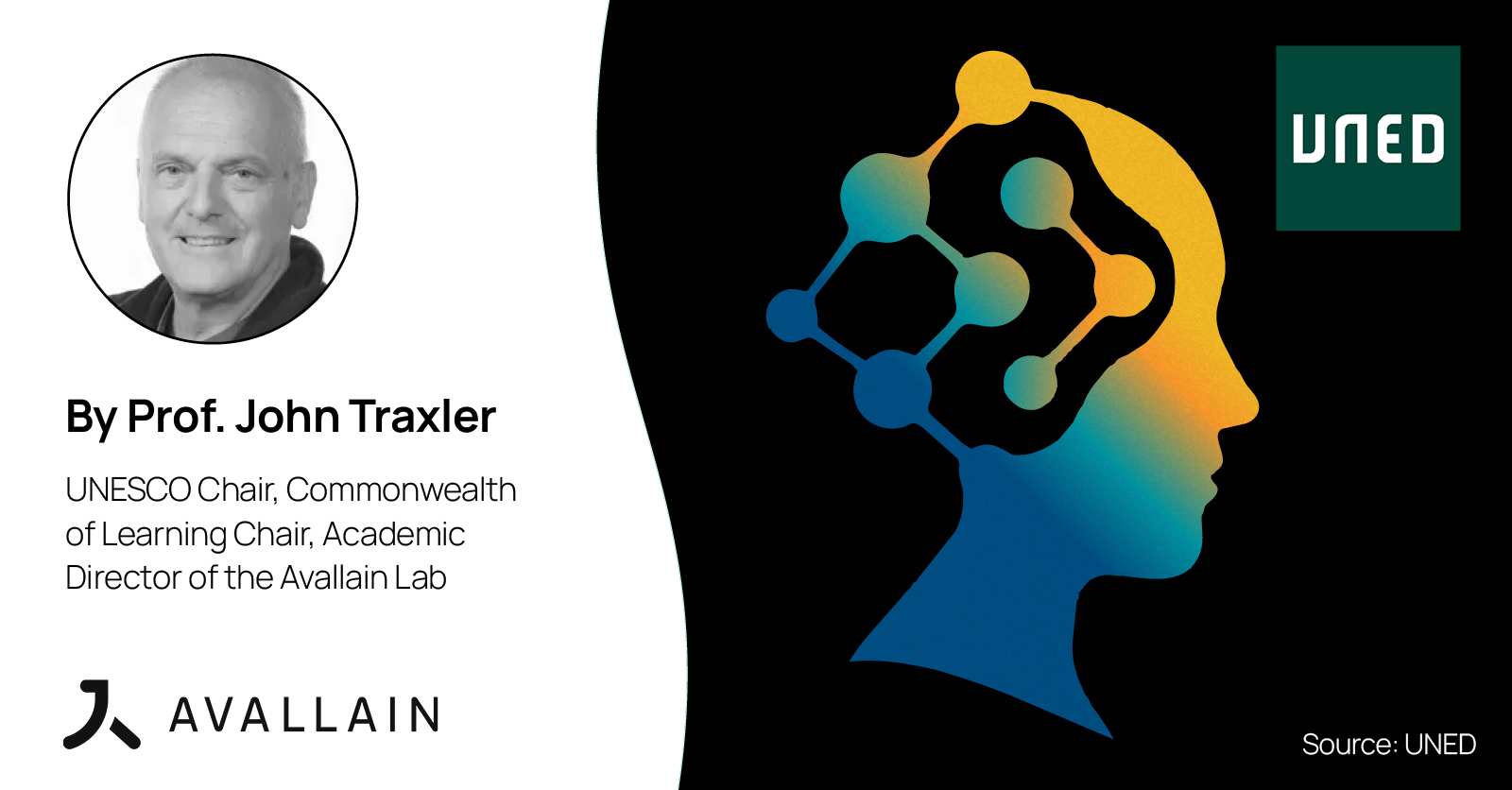
Author: Prof John Traxler, UNESCO Chair, Commonwealth of Learning Chair and Academic Director of the Avallain Lab
St. Gallen, January 16, 2026 – Language as a whole, language learning and digital education are evolving faster than ever, and all three are becoming more and more inextricably mixed as digital technologies, especially AI, become cheaper, easier and widely accessible, and societies become more and more global, connected, changeable and mobile.
This means that relevant research must not only be conducted quickly and effectively, but also disseminated and applied equally quickly and effectively, applied to technical development and pedagogic delivery, and extended beyond research communities. So the interface between academic research communities and the edtech sector needs to be effective and responsive, but it has its problems.
The Limits of Traditional Publishing
Publications, meaning books and journals, used to be the gold standard, their trustworthiness and relevance guaranteed by peer review processes conducted blind by expert reviewers. These are now less widely used, in general, because the rapidity of technical, educational and social change means they struggle to keep up, especially books, and they have very limited readership.
Research journals have their own unique problems; over the last decade, pressure from research funders, both UK and EU, has insisted on ‘open’ publication, meaning research journals must be freely available to any interested reader, no paywall, no subscription, no restrictions. This, however, has disrupted the publishers’ business model, which previously relied on libraries and readers paying to read. So now publishers must derive their income from writers, not readers, and introduce an APC (author processing charge) of several hundred to several thousand euros or dollars.
Professional researchers are, of course, still under the systemic pressure from their institutions to ‘publish or perish’ in order to increase their institutional rankings, and so ‘predatory journals’ emerge with dubious credentials and dubious quality assurance, happy to publish very quickly on receipt of the appropriate APC. AI has only amplified these problems, partly because of the rapidly increasing volume of AI research to be published and partly because some of it is probably specious, written by AI. This account is a slight simplification; there are exceptions to each of these assertions, but the general direction of travel is as described.
Responding to Change: Avallain Lab and the Importance of Dialogue
This state of affairs was, incidentally, one of the reasons for establishing the Avallain Lab, namely, creating a more responsive and trustworthy interface between research and the company, and building in expertise and experience as publication becomes less straightforward.
In turn, this shift means that the other medium of dissemination, namely gatherings, meaning seminars and conferences, becomes correspondingly more important.
This leads us to our collaboration with an upcoming conference on shared interests, including language, learning and digital technologies. The conference is one of the TISLID series in Spain, ‘Technological Innovation for Specialized Linguistic Domains’, a long-running conference series hosted by the ATLAS research group, ‘Applying Technology to Languages’, in UNED, Spain’s national distance learning university, based in Madrid. It takes place in Úbeda, Spain, from the 22nd to the 24th April 2026.
Rethinking Language Teaching and Linguistic Research in a Liquid World
The conference series aims to foster interdisciplinary dialogue among teachers, researchers and professionals on how to rethink language teaching and linguistic research in a liquid world, as Zygmunt Bauman’s theory suggests, a world never stable long enough to comprehend and is characterised by change, uncertainty and digitalisation.
‘Language Research and Education in Fluid Times: The Rise of Adaptive Competences’ is the conference theme for the next iteration. It focuses on the study, teaching and learning of languages, contextualised within a world in a constant and vertiginous state of evolution and transformation, of identity as well as relationships. This world is driven by multilingual needs and conditioned by globalisation, digital technology, mobility and artificial intelligence.
The title aims to suggest how human activity must adapt to unprecedentedly dynamic contexts in which linguistic, cultural, technological and communicative boundaries are increasingly blurred. In these contexts, human beings face uncertainty, diversity and new realities, some unforeseen, many ephemeral, that demand solutions that are both ethical and open, innovative and adaptive, hybrid and transdisciplinary.
The Rise of Adaptive Competence
In response to these conditions, the concept of adaptive competence becomes central. Rooted in soft or transversal skills, adaptive competence encompasses abilities such as cognitive flexibility, communicative resilience, digital and media literacy and intercultural competence.
The conference reflects a probable paradigm shift in language education and research, namely one that moves from stable, prescriptive frameworks toward fluid, adaptive models better aligned with the complexities and transformations of contemporary societies. With such a shift, edtech developers and the edtech sector clearly need to be closely and frequently listening to researchers and their findings. Avallain is pleased to be working with this community of researchers and to be involved in its conference and its publications as part of an ongoing mission to lead the sector in translating research into action.
For more than two decades, Avallain has enabled publishers, institutions and educators to create and deliver world-class digital education products and programmes. Our award-winning solutions include Avallain Author, an AI-powered authoring tool, Avallain Magnet, a peerless LMS with integrated AI, and TeacherMatic, a ready-to-use AI toolkit created for and refined by educators.
Our technology meets the highest standards with accessibility and human-centred design at its core. Through Avallain Intelligence, our framework for the responsible use of AI in education, we empower our clients to unlock AI’s full potential, applied ethically and safely. Avallain is ISO/IEC 27001:2022 and SOC 2 Type 2 certified and a participant in the United Nations Global Compact.
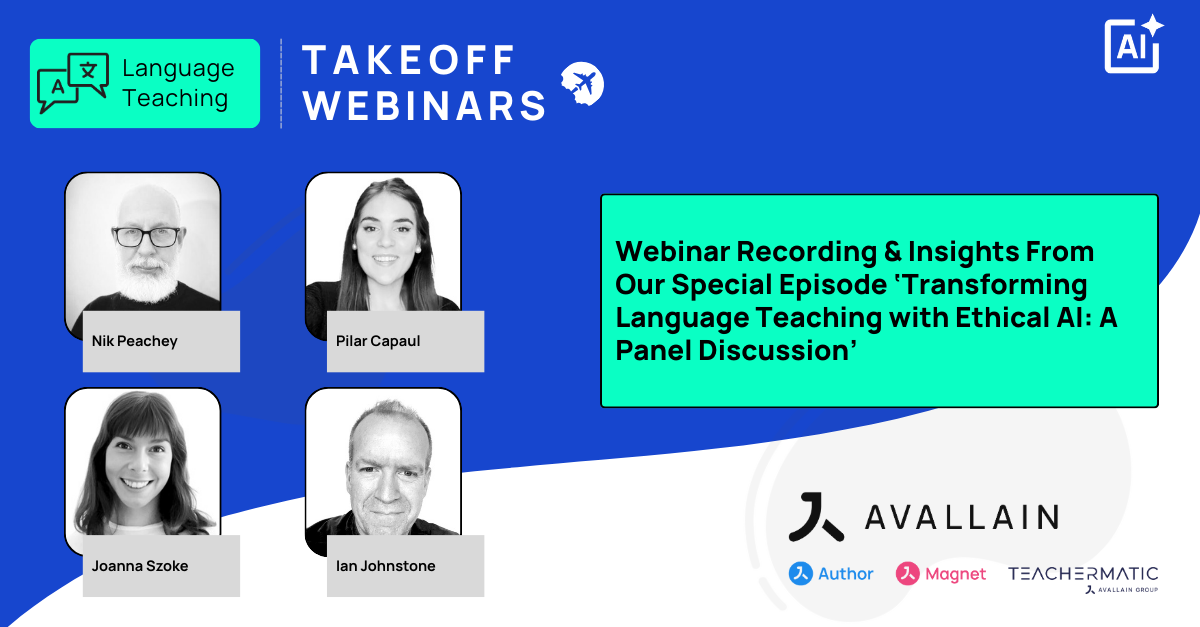
For the final episode of 2025, the Language Teaching Takeoff Webinar Series brought together experts from across language education and edtech to examine how AI can be adopted responsibly in teaching practice.
Responsibly Adopting AI in Language Education
London, December 2025 – In ‘Transforming Language Teaching with Ethical AI: A Panel Discussion’, educator and edtech consultant Nik Peachey, teacher and ELT content creator Pilar Capaul, teacher trainer and lecturer Joanna Szoke, and Ian Johnstone, VP Partnerships at Avallain, discussed ethical considerations, institutional responsibility and practical ways to integrate AI with confidence.
Moderated by Giada Brisotto, Senior Marketing and Sales Operations Manager at Avallain, the session examined how AI toolkits, such as the TeacherMatic Language Teaching Edition, can be used in teaching practice to improve efficiency without diminishing teacher agency.
The Potential and Advantages of AI in Language Teaching
Opening the discussion, Nik identified time as one of the most persistent challenges for language teachers, from marking and lesson planning to adapting materials for specific classroom contexts. He noted that while coursebooks provide structure, they are often designed for global audiences and may not fully reflect the needs of individual learners.
Nik explained that AI can help teachers adapt and extend materials more efficiently, supporting personalisation without adding complexity. He referenced AI toolkits such as the TeacherMatic Language Teaching Edition, where generators and CEFR-aligned inputs reduce reliance on prompt-writing skills and support differentiation, especially for learners with diverse needs.
From a teacher training perspective, Joanna reinforced this point by highlighting speed and responsiveness as key advantages. She explained how AI tools enable teachers to generate resources for niche teaching contexts and specific learner profiles, allowing educators and trainers to focus more on pedagogy and professional reflection rather than on content production.
AI in the Classroom: Practical Examples that Move Beyond Content Creation
Drawing on classroom experience, Pilar discussed how AI-generated activities can serve clear learning purposes rather than simply producing content.
Using TeacherMatic generators like ‘Have you done your homework’, she replaces a simple homework check with a diagnostic warm-up that reveals whether learners have truly understood a task, enabling her to decide how the lesson should progress and where support is most needed.
To make reading more purposeful, the ‘Ask an Expert’ generator prompts learners to read with intent, question information and evaluate meaning rather than read passively.
The Role of Education Technology Providers in Ethical AI Adoption
Shifting the discussion to institutional responsibility, Ian noted that education technology companies must ensure AI does not begin to lead educational practice. While new capabilities may appear compelling, he stressed that decision-making should remain educator-led, with tools designed to support teaching rather than dictate it.
Ian highlighted the importance of sustained research, classroom piloting and collaboration with educators and institutions to refine how AI is deployed in practice. He also emphasised the role of providers in sharing what they learn through structured guidance and training, empowering teachers and organisations to build confidence, develop informed approaches and navigate the broader shift AI is bringing to language education.
Where Does AI Add the Most Value for Language Teachers
The benefits of AI depend primarily on what teachers need to achieve. Joanna explained that for planning and administrative work, it can reduce time spent on tasks such as drafting reports or lesson outlines, provided teachers remain attentive to the data they share and treat outputs as a starting point rather than a final version. At the same time, she strongly argued for classroom use, where working with AI alongside students creates opportunities to model critical evaluation, ethical decision-making and responsible use, helping learners understand not just how to use these tools but also how to question them.
Ian reaffirmed that responsibility cannot sit solely with teachers. He added that education technology companies must take an active role in designing safeguards into AI toolkits, using clear interface guidance to discourage inappropriate use and implementing measures that reduce the risk of sensitive data being shared. By embedding these considerations at both the practical and systemic levels, edtech providers can ensure ethical use is built in by design, rather than relying on individual educators to navigate these challenges on their own.
Getting Started with AI in Daily Practice
Nik encouraged teachers to start small and let curiosity guide their first steps, suggesting they focus on a single area, such as planning, feedback or material creation, rather than trying to do everything at once. He advised identifying everyday pain points and using AI as a conversational partner to explore possible approaches. At the same time, Joanna added that teachers should not overcomplicate the process, noting that simple questions and natural interaction are often the most effective way to begin building confidence.
Ethics, Transparency and Authentic Classroom Use
Returning to the ethics question, Ian stressed the importance of preserving the dialogic nature of learning, ensuring that interaction remains a meaningful exchange rather than a one-way output. He explained that TeacherMatic is designed as an educational AI toolkit, with a built-in chat environment and filters that set clear boundaries for what can be shared and generated in a learning context, reducing the risk of inappropriate content or data misuse.
At an organisational level, Ian highlighted Avallain’s responsibility to underpin this work through ongoing research conducted by a dedicated lab, where academic expertise focuses on ethical frameworks, regulatory developments and the broader implications of AI use, including environmental impact. Together, these layers ensure that safeguards are embedded by design and continuously reviewed as technology evolves.
From a classroom perspective, Pilar examined how authenticity is maintained when AI-generated materials are shaped around real learners. Using the TeacherMatic AI toolkit, she highlighted the use of generators such as ‘Inspiration!’ and ‘Adapt your Content’ to create multiple versions of activities on the same topic. This allows students to work at an appropriate level, feel recognised and engage more confidently, reinforcing that AI-generated materials remain meaningful only when guided by teacher insight and an understanding of learner context.
Assessment, Exam Preparation and the Limits of Automation
Joanna addressed the use of AI in assessment by drawing a clear distinction between formative and summative contexts. For formative assessment, she highlighted the value of AI in generating feedback and action points to support ongoing learning, while emphasising the need for professional judgement. In summative contexts, she noted that although automated scoring can play a role for specific task types, final decisions should remain with the teacher, adding that when working with AI, ‘I will be curious and cautious.’
Building on this, Ian reinforced that generative AI should not be positioned as a decision-maker in summative assessment. He explained that language models form a new understanding each time they evaluate a piece of work and do not draw on the accumulated experience of a trained language teacher. As a result, they can offer multiple, variable interpretations rather than a consistent, auditable evaluation. For summative contexts, he argued, there should always be a role for teacher review and moderation, noting that only rule-based, algorithmic approaches, where assessment criteria are explicitly defined and auditable, may be appropriate for high-stakes decisions.
Looking at day-to-day teaching, Pilar drew on her experience preparing learners for international exams, particularly teenagers who may feel disengaged or under pressure. She explained how the rollout of the TeacherMatic ‘Cambridge Style Exam Prep Generator’ has enabled her to personalise exam-style activities around familiar topics, helping sustain motivation while maintaining relevance. Working in a bilingual setting with varying proficiency, she also described how creating resources on the same content at different levels enabled all students to prepare together while still working at a level that felt appropriate and achievable.
Looking Ahead: Supporting Teachers as AI Tools Evolve
AI toolsets will increasingly become multimodal, enabling teachers to generate audio, images, video and presentations alongside text. Nik noted that this could significantly reduce the time teachers spend searching for suitable media, allowing them to create more stimulating, multimedia-rich lessons and adapt more easily to online or blended learning environments.
Ian expanded on this by placing these developments within a broader roadmap for educational AI. While TeacherMatic already supports the creation of worksheets and lesson plans, he explained that interactive learning experiences are the next step. Drawing on Avallain’s background in interactive content, he outlined how integrating generative capabilities with interactive courseware will enable teachers to deliver more engaging activities and assignments directly in the classroom, rather than treating interactivity as a separate layer.
Joanna emphasised that technology alone is not enough. She stressed the importance of building teacher confidence and critical awareness, encouraging educators to experiment, ask questions and practise with AI tools while remaining alert to hype. Maintaining professional judgement, she argued, means staying attentive to how outputs are generated and preserving a healthy distance between automated suggestions and pedagogical decision-making.
Ethical Adoption as a Shared Responsibility
The value of AI in language education depends on how thoughtfully it is adopted. When pedagogy leads, and professional judgement remains central, AI toolkits, such as TeacherMatic, can empower teachers to manage their workload, design purposeful learning activities and respond more effectively to diverse learner needs.
At the same time, ethical adoption requires shared responsibility. Teachers need space to experiment critically and build confidence, while education technology providers must ensure safeguards, transparency and ongoing research are embedded by design.
Explore the TeacherMatic Language Teaching Edition
The TeacherMatic Language Teaching Edition is an AI toolkit specifically designed for language educators. Through its purpose-built AI generators, teachers can create activities, support planning, approach assessment and more with greater consistency and control, while reducing time spent on routine tasks.
Create Dynamic and Engaging Exam Practice for Your Students
🗓 Thursday, 22nd January 🕛 12:00 – 12:30 GMT | 13:00 – 13:30 CET
The next edition of the Language Teaching Takeoff Webinar Series will welcome Joanna Szoke. A freelance teacher trainer and AI in education specialist, she will open the new year with a practical session focused on exam preparation.
Her first episode will demonstrate the ‘Cambridge Style Exam Prep Generator’ within the TeacherMatic Language Teaching Edition, alongside other generators designed for assessment-focused use. The session will explore how teachers can create engaging exam-style practice, adapt tasks to different learner needs and approach assessment in ways that support confidence and progression.
For more than two decades, Avallain has enabled publishers, institutions and educators to create and deliver world-class digital education products and programmes. Our award-winning solutions include Avallain Author, an AI-powered authoring tool, Avallain Magnet, a peerless LMS with integrated AI, and TeacherMatic, a ready-to-use AI toolkit created for and refined by educators.
Our technology meets the highest standards with accessibility and human-centred design at its core. Through Avallain Intelligence, our framework for the responsible use of AI in education, we empower our clients to unlock AI’s full potential, applied ethically and safely. Avallain is ISO/IEC 27001:2022 and SOC 2 Type 2 certified and a participant in the United Nations Global Compact.