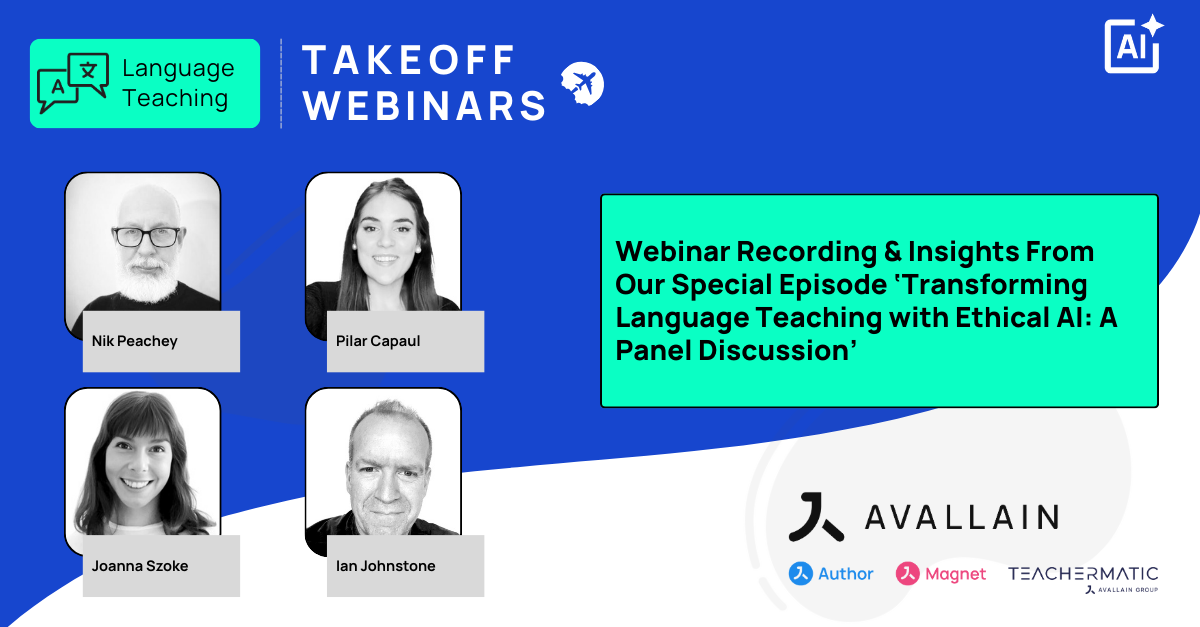
For the final episode of 2025, the Language Teaching Takeoff Webinar Series brought together experts from across language education and edtech to examine how AI can be adopted responsibly in teaching practice.
Responsibly Adopting AI in Language Education
London, December 2025 – In ‘Transforming Language Teaching with Ethical AI: A Panel Discussion’, educator and edtech consultant Nik Peachey, teacher and ELT content creator Pilar Capaul, teacher trainer and lecturer Joanna Szoke, and Ian Johnstone, VP Partnerships at Avallain, discussed ethical considerations, institutional responsibility and practical ways to integrate AI with confidence.
Moderated by Giada Brisotto, Senior Marketing and Sales Operations Manager at Avallain, the session examined how AI toolkits, such as the TeacherMatic Language Teaching Edition, can be used in teaching practice to improve efficiency without diminishing teacher agency.
The Potential and Advantages of AI in Language Teaching
Opening the discussion, Nik identified time as one of the most persistent challenges for language teachers, from marking and lesson planning to adapting materials for specific classroom contexts. He noted that while coursebooks provide structure, they are often designed for global audiences and may not fully reflect the needs of individual learners.
Nik explained that AI can help teachers adapt and extend materials more efficiently, supporting personalisation without adding complexity. He referenced AI toolkits such as the TeacherMatic Language Teaching Edition, where generators and CEFR-aligned inputs reduce reliance on prompt-writing skills and support differentiation, especially for learners with diverse needs.
From a teacher training perspective, Joanna reinforced this point by highlighting speed and responsiveness as key advantages. She explained how AI tools enable teachers to generate resources for niche teaching contexts and specific learner profiles, allowing educators and trainers to focus more on pedagogy and professional reflection rather than on content production.
AI in the Classroom: Practical Examples that Move Beyond Content Creation
Drawing on classroom experience, Pilar discussed how AI-generated activities can serve clear learning purposes rather than simply producing content.
Using TeacherMatic generators like ‘Have you done your homework’, she replaces a simple homework check with a diagnostic warm-up that reveals whether learners have truly understood a task, enabling her to decide how the lesson should progress and where support is most needed.
To make reading more purposeful, the ‘Ask an Expert’ generator prompts learners to read with intent, question information and evaluate meaning rather than read passively.
The Role of Education Technology Providers in Ethical AI Adoption
Shifting the discussion to institutional responsibility, Ian noted that education technology companies must ensure AI does not begin to lead educational practice. While new capabilities may appear compelling, he stressed that decision-making should remain educator-led, with tools designed to support teaching rather than dictate it.
Ian highlighted the importance of sustained research, classroom piloting and collaboration with educators and institutions to refine how AI is deployed in practice. He also emphasised the role of providers in sharing what they learn through structured guidance and training, empowering teachers and organisations to build confidence, develop informed approaches and navigate the broader shift AI is bringing to language education.
Where Does AI Add the Most Value for Language Teachers
The benefits of AI depend primarily on what teachers need to achieve. Joanna explained that for planning and administrative work, it can reduce time spent on tasks such as drafting reports or lesson outlines, provided teachers remain attentive to the data they share and treat outputs as a starting point rather than a final version. At the same time, she strongly argued for classroom use, where working with AI alongside students creates opportunities to model critical evaluation, ethical decision-making and responsible use, helping learners understand not just how to use these tools but also how to question them.
Ian reaffirmed that responsibility cannot sit solely with teachers. He added that education technology companies must take an active role in designing safeguards into AI toolkits, using clear interface guidance to discourage inappropriate use and implementing measures that reduce the risk of sensitive data being shared. By embedding these considerations at both the practical and systemic levels, edtech providers can ensure ethical use is built in by design, rather than relying on individual educators to navigate these challenges on their own.
Getting Started with AI in Daily Practice
Nik encouraged teachers to start small and let curiosity guide their first steps, suggesting they focus on a single area, such as planning, feedback or material creation, rather than trying to do everything at once. He advised identifying everyday pain points and using AI as a conversational partner to explore possible approaches. At the same time, Joanna added that teachers should not overcomplicate the process, noting that simple questions and natural interaction are often the most effective way to begin building confidence.
Ethics, Transparency and Authentic Classroom Use
Returning to the ethics question, Ian stressed the importance of preserving the dialogic nature of learning, ensuring that interaction remains a meaningful exchange rather than a one-way output. He explained that TeacherMatic is designed as an educational AI toolkit, with a built-in chat environment and filters that set clear boundaries for what can be shared and generated in a learning context, reducing the risk of inappropriate content or data misuse.
At an organisational level, Ian highlighted Avallain’s responsibility to underpin this work through ongoing research conducted by a dedicated lab, where academic expertise focuses on ethical frameworks, regulatory developments and the broader implications of AI use, including environmental impact. Together, these layers ensure that safeguards are embedded by design and continuously reviewed as technology evolves.
From a classroom perspective, Pilar examined how authenticity is maintained when AI-generated materials are shaped around real learners. Using the TeacherMatic AI toolkit, she highlighted the use of generators such as ‘Inspiration!’ and ‘Adapt your Content’ to create multiple versions of activities on the same topic. This allows students to work at an appropriate level, feel recognised and engage more confidently, reinforcing that AI-generated materials remain meaningful only when guided by teacher insight and an understanding of learner context.
Assessment, Exam Preparation and the Limits of Automation
Joanna addressed the use of AI in assessment by drawing a clear distinction between formative and summative contexts. For formative assessment, she highlighted the value of AI in generating feedback and action points to support ongoing learning, while emphasising the need for professional judgement. In summative contexts, she noted that although automated scoring can play a role for specific task types, final decisions should remain with the teacher, adding that when working with AI, ‘I will be curious and cautious.’
Building on this, Ian reinforced that generative AI should not be positioned as a decision-maker in summative assessment. He explained that language models form a new understanding each time they evaluate a piece of work and do not draw on the accumulated experience of a trained language teacher. As a result, they can offer multiple, variable interpretations rather than a consistent, auditable evaluation. For summative contexts, he argued, there should always be a role for teacher review and moderation, noting that only rule-based, algorithmic approaches, where assessment criteria are explicitly defined and auditable, may be appropriate for high-stakes decisions.
Looking at day-to-day teaching, Pilar drew on her experience preparing learners for international exams, particularly teenagers who may feel disengaged or under pressure. She explained how the rollout of the TeacherMatic ‘Cambridge Style Exam Prep Generator’ has enabled her to personalise exam-style activities around familiar topics, helping sustain motivation while maintaining relevance. Working in a bilingual setting with varying proficiency, she also described how creating resources on the same content at different levels enabled all students to prepare together while still working at a level that felt appropriate and achievable.
Looking Ahead: Supporting Teachers as AI Tools Evolve
AI toolsets will increasingly become multimodal, enabling teachers to generate audio, images, video and presentations alongside text. Nik noted that this could significantly reduce the time teachers spend searching for suitable media, allowing them to create more stimulating, multimedia-rich lessons and adapt more easily to online or blended learning environments.
Ian expanded on this by placing these developments within a broader roadmap for educational AI. While TeacherMatic already supports the creation of worksheets and lesson plans, he explained that interactive learning experiences are the next step. Drawing on Avallain’s background in interactive content, he outlined how integrating generative capabilities with interactive courseware will enable teachers to deliver more engaging activities and assignments directly in the classroom, rather than treating interactivity as a separate layer.
Joanna emphasised that technology alone is not enough. She stressed the importance of building teacher confidence and critical awareness, encouraging educators to experiment, ask questions and practise with AI tools while remaining alert to hype. Maintaining professional judgement, she argued, means staying attentive to how outputs are generated and preserving a healthy distance between automated suggestions and pedagogical decision-making.
Ethical Adoption as a Shared Responsibility
The value of AI in language education depends on how thoughtfully it is adopted. When pedagogy leads, and professional judgement remains central, AI toolkits, such as TeacherMatic, can empower teachers to manage their workload, design purposeful learning activities and respond more effectively to diverse learner needs.
At the same time, ethical adoption requires shared responsibility. Teachers need space to experiment critically and build confidence, while education technology providers must ensure safeguards, transparency and ongoing research are embedded by design.
Explore the TeacherMatic Language Teaching Edition
The TeacherMatic Language Teaching Edition is an AI toolkit specifically designed for language educators. Through its purpose-built AI generators, teachers can create activities, support planning, approach assessment and more with greater consistency and control, while reducing time spent on routine tasks.
Next in the Webinar Series
Create Dynamic and Engaging Exam Practice for Your Students
🗓 Thursday, 22nd January
🕛 12:00 – 12:30 GMT | 13:00 – 13:30 CET
The next edition of the Language Teaching Takeoff Webinar Series will welcome Joanna Szoke. A freelance teacher trainer and AI in education specialist, she will open the new year with a practical session focused on exam preparation.
Her first episode will demonstrate the ‘Cambridge Style Exam Prep Generator’ within the TeacherMatic Language Teaching Edition, alongside other generators designed for assessment-focused use. The session will explore how teachers can create engaging exam-style practice, adapt tasks to different learner needs and approach assessment in ways that support confidence and progression.
About Avallain
For more than two decades, Avallain has enabled publishers, institutions and educators to create and deliver world-class digital education products and programmes. Our award-winning solutions include Avallain Author, an AI-powered authoring tool, Avallain Magnet, a peerless LMS with integrated AI, and TeacherMatic, a ready-to-use AI toolkit created for and refined by educators.
Our technology meets the highest standards with accessibility and human-centred design at its core. Through Avallain Intelligence, our framework for the responsible use of AI in education, we empower our clients to unlock AI’s full potential, applied ethically and safely. Avallain is ISO/IEC 27001:2022 and SOC 2 Type 2 certified and a participant in the United Nations Global Compact.
_
Contact:
Daniel Seuling
VP Client Relations & Marketing
