The challenge in edtech is not simply to innovate but to do so with purpose. So how do organisations identify the opportunities most worth pursuing? In this piece, Prof. John Traxler draws on academic and consultancy perspectives to explore different approaches to identifying those opportunities, from brainstorming and horizon scanning to market research and AI. This article offers a broad overview and perspective on how the edtech sector can approach innovation more deliberately.
Scanning, Researching and Rethinking Innovation in Edtech Development
Author: Prof John Traxler, UNESCO Chair, Commonwealth of Learning Chair and Academic Director of the Avallain Lab
The Challenges
St. Gallen, May 28, 2026 – Where does our next edtech product come from? How do we spot good ideas, or create them, whilst avoiding the bad and the old ones? How do we avoid simply copying our competitors and do more than merely comply with our clients? How do we do more than enhance and improve the status quo? How do we fight off ‘stuckness’? We should also ask whether, in fact, the edtech sector differs much from other sectors where software systems are developed or perhaps any other kind of product?
Each exists in its own world of stakeholders, regulations, procedures, traditions and resources. What distinguishes software development is that the raw materials are merely data and instructions, free and limitless, perhaps mistakenly suggesting that innovation is without cost. Its traditions and procedures have expanded, evolved and mutated incredibly rapidly, over less than a working lifetime. Together, these mean that the questions we raise do not have tried-and-tested answers. The ethos of developers is also a factor: are they hungry, visionary start-ups, or reliable, quality-conscious corporates, and how does each approach these questions?
Furthermore, edtech products that support education systems operate in contexts where multiple, conflicting stakeholders make achieving consensus on ‘good’ edtech very problematic.
This blog addresses these kinds of questions, but as understood by an academic who has moved into the edtech sector, drawing on consultancy and research experiences, hoping to provoke questions and reactions and perhaps some changes. This reflects part of the Avallain Lab’s wider mission to foster productive relationships between academia, the sector and its clients.
A previous blog discussed the echo chamber/revolving door that seems evident in the people and processes of institutional IT procurement, and, in the current context, this may be a brake on change and innovation, excluding some technical voices and perspectives, fostering incremental quantitative improvement rather than radical qualitative transformation. Again, problematised by uncertainty about what constitutes ‘good’ edtech products in education systems that are very unconfident and uncertain about their own purpose.
Brainstorming
To start upstream, brainstorming is a recognised technique, widely described across the media, not just undisciplined musings or mutterings. Brainstorming is a creative technique for generating many new ideas about a problem or topic, focusing on quantity over quality initially, deferring judgement, encouraging wild ideas and building on others’ suggestions in a free-flowing, often group-based session. The basic rules are:
- Suspend judgement during the initial phase; don’t let criticism kill the momentum.
- Encourage wild ideas; they contain the seed of a practical, breakthrough feature.
- Go for quantity; clear out the obvious ideas to reach the innovative ones underneath.
- Combine and improve participants’ ideas; transform simple ideas into better ones, building on shared contributions.
Common sense suggests the best number of people to be involved is fewer than perhaps ten, to avoid chaos and confusion, and ‘hiding’, but more than perhaps five, to avoid stagnation. Still, clearly, composition is important, with similarity and homogeneity fostering candour and spontaneity, whilst differences in hierarchy might be inhibiting. There is, however, an argument for neurodiversity or diverse cognitive styles, but all this presupposes a large enough pool of potential participants in which to make these kinds of choices. Obviously, the physical setting is important; different settings all send different signals to different demographics and cultures, as does the timing. One possibility is the away-day format, cut off from daily pressures and obligations, and a moderator might prevent groupthink and give space to quieter, tentative voices. There is perhaps some overlap with the heuristics for effective focus groups, including tips for effective moderation that ensure a free-flowing, non-judgemental event.
Incidentally, boredom too has its uses, all the more so as phones and computers often keep it at bay, creating opportunities for creativity or originality.
These established formats and prescriptions for effective brainstorming are mostly pre-COVID and assume that working and meeting face-to-face are the norm. This is clearly no longer the case with many people, perhaps the more creative or imaginative, who are either working online from home or digitally nomadic. Their varied individual settings, disruptive external events, such as a delivery at the door, lunch burning and the changed cues, language and tacit protocols of online interaction, might not be so conducive to spontaneity or candour.
Perhaps the move of the Delphi technique events from face-to-face synchronous to asynchronous online, for all sorts of pragmatic reasons, might suggest a compromise format that reconciles individual creativity with group interactivity, with the added bonus of the latter being digitally recorded and preserved.
Whilst these might be prescriptions for effective brainstorming, they do not address when to brainstorm in relation to any product development cycle or how to feed the outcomes into the mainstream of developments; there are presumably good ways and bad ways, and at the risk of going off at a tangent, this looks like an opportunity for ‘diffusion of innovations’ approaches to find the good ways and the factors that determine which best way.
Horizon Scanning
Horizon scanning is a way of spotting possibilities coming towards us, for example, of managing those possibilities that brainstorming has surfaced.
Some background: several years ago, I collaborated with Alison Potter from the TEL division of Health Education England (South), part of the UK NHS, to review horizon scanning and to formalise and embed it in their routines. Horizon scanning attempts to spot concepts, opportunities and technologies before they reach the market (and before they reach the competitors, hoping to catch the next Teflon or Post-it before they do), especially those not immediately and obviously relevant, the ones off in left field.
The work examined organisations comparable in size and technology to the NHS, including the UK government’s Cabinet Office, and distilled their procedures into a set for the NHS. Our initial research question was, ‘What models exist for identifying and then prioritising which new and emerging technologies might add value to healthcare education in the UK?’ We conducted a literature review of horizon-scanning methods to identify existing models and systems. Then we conducted interviews with six experts across education, government, healthcare and the independent strategic foresight sector. The findings from the literature shaped the interview design. Interviews comprised of three parts: a short experiment to gauge how each expert horizon scans, their reaction to our proposed framework and lastly, their thoughts on the skills and tools necessary to horizon scan.
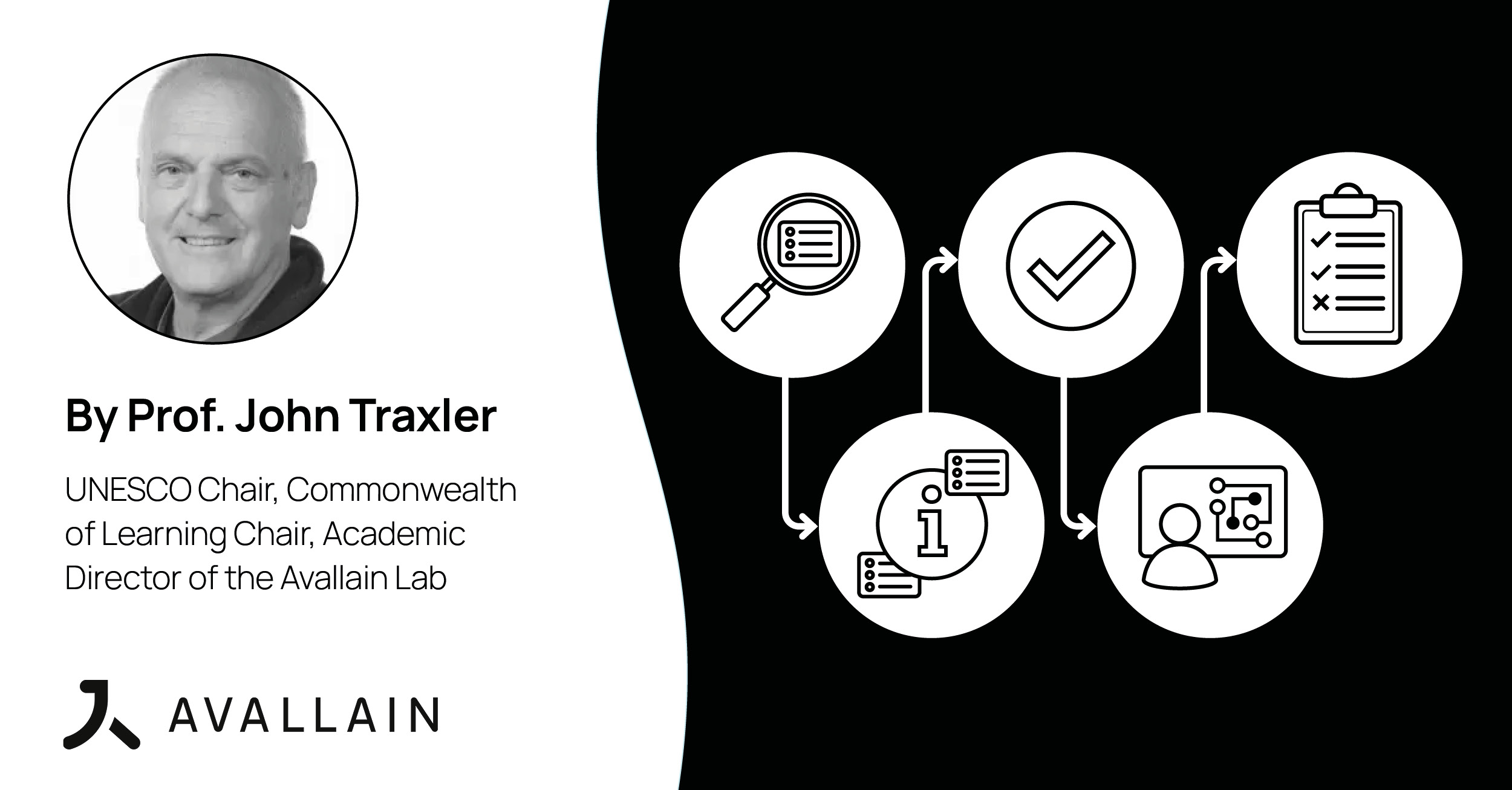
Alison’s final version of the horizon-scanning framework, the culmination of the whole research process, features a sequence of several distinct activities, and her paper goes into greater detail.
- Identification, or scanning a defined set of sources, addressing what is out there
- Classifying, or filtering, then prioritising, addressing what is relevant
- Assessing, addressing, what is its potential impact
- Disseminating, or navigating, addressing where it needs to go
- Evaluating, or reflecting, addressing how we do it better
And then, start again, perhaps on some predetermined cycle time matched to the organisational timescales and responsiveness.
We should, however, always bear in mind, when defining the sources to be scanned, assessing the impact of any discoveries and disseminating them, that any such discoveries need to align with various commercial, technical and organisational factors. These factors might include the headroom and skill set among staff, the alignment with the existing product portfolio and client base, and the organisation’s management of change.
These factors are, in effect, among those identified in the diffusion of innovations community, a body of expertise stretching back many decades, tackling innovations from new technical products to changed farming practices to improved attitudes to smoking and drink-driving. In this context, the ‘innovation’ is the horizon-scanning discovery. Diffusion of Innovations work in its various forms over the years looks at factors such as the characteristics of the people involved, perhaps the developers inside edtech or the clients outside, whether they are naturally risk-taking or risk-averse, the development, whether it can be deployed without a tangle of interoperability issues, whether it can be easily explained and understood (and sold), the nature of any competitive advantage, so on.
It does, however, leave the sources to be scanned unanswered. Horizon scanning is one; others might exploit the expertise and experience of researchers, described briefly later, exploiting their literature searching skills, their contacts and their colleagues, and also their intuitions and ability to pick up ‘weak signals’.
Market Research
Looking now at market research as another source of innovative ideas, I am deeply indebted over the years to the work of Gordon Rugg on knowledge and its elicitation, in every kind of research that involves people, meaning clients, users, learners and the wider market. This work recognises that people know, believe and feel all sorts of different things and that finding out what they are thus requires all sorts of different techniques and tools. This work is expressed as the ACRE, ACquisition of REquirements, framework, a tabulation that goes from every type of knowledge or feeling or value to the most effective tool or technique for eliciting it, from the conventional, namely surveys, questionnaires, etc., to the ‘contrived’, such as card sorts, rep grids and laddering, to the physical, such as models and prototypes. Within this overarching framework, there is still the need for adaptation, refinement and common sense, so don’t ask compound or double-negative questions; do make sure participants are not hungry, uncomfortable or embarrassed and so on.
In my work, I have often lambasted ‘the usual suspects’ of social science (and market research), namely the focus group, the interview, the questionnaire and the survey, rounded up unthinkingly to answer every conceivable question, as ethically problematic, methodologically deeply flawed and usually inappropriate.
Without unpacking and explaining all of the alternatives to the ‘usual suspects’, which you can unpack here, it might suffice to say that asking questions only provides the answers to those questions, even assuming the respondent is able and willing to give an adequate, honest answer, rather than finding out what is actually important to the respondent. Furthermore, asking questions about desirable futures only elicits answers based on modified presents and remembered pasts rather than any radically reimagined futures.
These are the weaknesses in expecting clients or users – actually, users are not always asked, often their managers or IT do so on their behalf – to guide future products or projects; merely asking them will likely elicit only requests for what they already have, but faster, easier, bigger or bug-free. So perhaps academic research can represent a more rigorous version of market research?
‘Real’ Research
Separating market research from ‘real’ research is an artificial and unnecessary distinction, since both should be activities aimed at acquiring, analysing, understanding and contextualising what people know or want or feel in ways that are trustworthy, cheap, appropriate, ethical and efficient. Both can suffer from exactly the same flaws because each, in its own sphere, is subject to very similar pressures and constraints. The distinction might in fact be between the people, the market research researchers on the one hand and academic researchers on the other, and on the expectations, timescales and resources around their different professions. The question here is, what can academic researchers contribute?
Two things, really, namely, what might be called primary and what might be called secondary research, the former being actually doing stuff, conducting empirical studies, setting up interventions, taking measurements, listening to people, building prototypes and running workshops, the latter being connecting with the outputs and activities of the people who are doing primary research, using experience and expertise, to understand what is happening and what might be useful, an informal version of horizon scanning in practice.
It has to be said that primary research, especially in the context of commercial edtech, is probably a waste of time, since any commercial advantage is likely to be small and short-term, though it may have value as an agent of culture change within an organisation, raising awareness of methods and limitations, and this may be something of indirect commercial value. There is a far better case for secondary research since it spreads the risks and costs and is perhaps a semi-intuitive version of horizon-scanning, based on gut feelings and looking for otherwise undetected ‘weak signals’. This rationale underpins the Avallain Lab, built on expertise and experience that a search engine or chatbot can’t simulate and tapping into contacts and colleagues before their work hits the public domain. This model is still being refined.
Process Maturity
To go off at a tangent, process maturity models have recently been spotted being applied to AI development, though not yet to educational AI development, and that may be an important or provocative opportunity.
Process maturity and its models are ways of describing how well an organisation handles bugs, mistakes and mishaps. If an organisation just deals with them as they crop up, it might be categorised as relatively immature. It may, however, document or record them, perhaps analyse and reflect on them, and have procedures for analysis and reflection, and indeed departments and specialisms for doing this, indicating a progressively more mature organisation. These stages have been formalised as process maturity models, progressing from chaotic (Level 1) to consistently effective and optimised (Level 5), using models to standardise procedures, enhance quality, boost efficiency and ensure scalability to achieve strategic goals (and, accordingly, to gain certification). This approach was adopted in large-scale software development in the 1990s; for example, the Capability Maturity Model of the 1980s. Also, later, in courseware development and now, it seems, in some AI development and perhaps next in future edtech development, why not?
The relationship between notions of process maturity and the other earlier topics is, however, oblique; the first ones talk about qualitative or strategic jumps, thinking ‘outside the box’, about breaking away from the established trajectory, whereas the last one talks about incremental quantitative or technical improvement, about moving along the established trajectory but more effectively and efficiently, ‘inside the box’. They must, however, be reconciled; otherwise, organisations risk either forever improving the past or never shaping the future.
The way forward may be to treat brainstorming and horizon scanning as processes in their own right, ones that, on reflection, could be monitored and measured and thus improved, but also then feed into roadmaps. In essence, the way forward must reconcile the tensions between the ‘stay hungry’ of start-ups and the quality assurance expected of established organisations.
Artificial Intelligence
These are all largely pre-digital accounts, and we should now perhaps look for digital tools that capture these methods and techniques, especially for AI tools, the generative ones that answer our questions and the agentic ones that execute our processes. At the moment, however, the best advice might be to proceed with caution. Current AI, working on probabilistic mechanisms, risks emphasising the existing norms rather than breaking away from them; perhaps ‘hallucinations’ have a part to play. One under-researched area comprises scenarios depicting how society, its education systems, the economy, its labour markets and the workforce and their skill sets will evolve under the impact of artificial intelligence. In their different ways, these all form the contexts of edtech products and how they are developed.
Finally
This piece outlines how disparate techniques from disparate communities might have productive synergy. Each technique, and probably others, deserves greater attention in order to explore adaptation and integration. Taken together, they offer useful perspectives on how edtech organisations might think more deliberately about identifying meaningful opportunities, challenging established assumptions and navigating future change. The impact of AI is currently limited to answering questions and making discrete activities more efficient. Clearly, it won’t stop there.
About Avallain
For more than two decades, Avallain has enabled publishers, institutions and educators to create and deliver world-class digital education products and programmes. Our award-winning solutions include Avallain Author, an AI-powered authoring tool, Avallain Magnet, a peerless LMS with integrated AI, and TeacherMatic, a ready-to-use AI toolkit created for and refined by educators.
Our technology meets the highest standards with accessibility and human-centred design at its core. Through Avallain Intelligence, our framework for the responsible use of AI in education, we empower our clients to unlock AI’s full potential, applied ethically and safely. Avallain is ISO/IEC 27001:2022 and SOC 2 Type 2 certified and a participant in the United Nations Global Compact.
Find out more at avallain.com
_
Contact:
Daniel Seuling
VP Client Relations & Marketing
