What’s the Purpose of Education?

What is education ultimately for? While the answers have long been debated, rapid advances in digital technologies and artificial intelligence are encouraging us to reconsider many of the assumptions that have shaped education systems for decades. In this article, Prof. John Traxler explores the competing purposes that education has historically been expected to serve, from supporting economic and social priorities to fostering personal development and informed citizenship. He considers how digital technologies and artificial intelligence are reshaping these long-held perspectives and reflects on what this means for educators, learners and the future purpose of education itself.

What’s the Purpose of Education?

Author: Prof John Traxler, UNESCO Chair, Commonwealth of Learning Chair and Academic Director of the Avallain Lab

St. Gallen, July 27, 2026 – There has always been debate and confusion about the nature and purpose of education and how educators should respond to the different views and pressures being expressed. Some of the most pragmatic and widespread have been about the economy and employment, placing learners into jobs, while others have emphasised the obligation of education systems to produce good citizens, good parents, entrepreneurs and artists. 

The growing presence of digital technologies within our societies and economies changes some of these pressures and views, while also changing how education systems can respond to them. And now, artificial intelligence accelerates and intensifies all of these pressures, adding new possibilities and new problems, often faster than education systems or indeed the edtech sector can respond. This blog from the Avallain Lab unpacks some of these pressures, problems and possibilities in order to give colleagues and clients a broader perspective.

Defining the Tension: Education vs The System

It is perhaps sensible to distinguish between ‘education’ and ‘the education system’ and to accept that there is a difference. The education system is not merely an abstract entity or the specific organisations and institutions that deliver education, and does absolutely nothing else. The education system, and its organisations and institutions, is often obliged to do and deliver all manner of things that might challenge understandings of ‘education’. Precisely because the education system serves many different stakeholders, it is often expected to fulfil purposes that extend beyond education itself.

Of course, countries, communities and cultures differ, and thus so do their understandings of education; furthermore, understandings within individual communities, countries and cultures, among families and individuals, will also differ. Education systems in democracies can, however, embrace many of these different and probably divergent understandings by not exposing them or discussing them too much, ‘letting sleeping dogs lie’ or not exploring too deeply what they might mean in practice or what they might tell us about our community, culture or country that we would rather not acknowledge.

The idea that the education system is basically and cynically a political device supporting a conservative political or economic elite is one such understanding. It is exemplified by the notion that the system is essentially a crèche that frees up parents to service the economy by making them available for employment. It is also reflected in the notion that increased participation in further or higher education hides youth unemployment, a critique often levelled at the UK’s various ‘youth opportunities’ or skills training in the 1980s, which compulsory national service does in many other countries.

Another example is the notion that there is some kind of ‘hidden curriculum’ intended to produce the next generation of compliant consumers, passive citizens and docile workers. There is moreover a notion that education, whatever it might mean, is the engine of social mobility, that education will enable the acquisition of riches, whereas quite often it might be that riches enable the acquisition of education and thus reinforces a state of social immobility, or more crudely for example, from an affluent family you can afford to stay on at school and then progress to a university education. 

The Systemic Pressures on Modern Education

These various depictions, even if plausible, need reworking as the 4IR (the fourth industrial revolution), the synergy of data communications, the internet of things, digital technologies, robotics and, of course, artificial intelligence, bites ever harder. This is effecting the ongoing ‘hollowing out of the labour market’, the erosion of jobs as the machines take over, eventually leaving only jobs for the likes of street sweepers and brain surgeons, at the two extremes, everything in the middle having disappeared. 

If there is, in fact, a cynical and political understanding of the education system, then it will need to embrace increasingly widespread unemployment and the widespread social tensions that accompany it. We could extend this interpretation to suggest that education systems, at the same time, will also have to address the apparently ever-increasing geopolitical instability as the post-war so-called ‘rules-based world order’ disintegrates and will have to address how climate change stresses economies, environments, infrastructure and populations. These are big challenges, not separate, disconnected or unrelated. 

Utopian vs. Dystopian Perspectives

There is also what might be called a utopian alternative to this previous dystopian analysis, namely that education systems are intended in some vague way to produce well-rounded individuals. They are articulate, cultivated, liberal, balanced, creative and wholesome; somehow better citizens, neighbours, voters, parents and perhaps these days, ones that are resistant to demagogy, extremism and crass materialism. This might be reflected in the German notion of Bildung, the Renaissance Man (man, really?) or the Confucian ideals of harmony, order and stability. However, because of its abstract nature and intangible outcomes, it is harder to operationalise and evaluate than the dystopian alternative. 

It is very, very possible to see these two versions as identical in substance but merely viewed through two different lenses. It is also possible to ask whether education systems lead societies, follow societies or merely reflect them. Leading societies might expose educators to accusations of presumption and arrogance in the case of the utopian version, whereas following societies may expose educators to accusations of compliance, complicity and subservience in the case of the dystopian one. 

More consensual, explicit and obvious understandings are somewhere in the middle. Producing well-rounded individuals, while a noble aspiration, might be viewed as inadequate if such individuals are unemployable, not only when they leave the education system but also throughout their lives. Lifelong learning is one sensible and acceptable response, developing the necessary generic skills, attitudes, knowledge and abilities while not seeming to be mere ‘training’. Training is, however, always lurking in the wings, ready to pounce and appropriate the nobler ideals of education to produce, for example, ‘jobs-ready graduates’ and taxpayers. However, it has to be said that any hoped-for alignment of the education system to the needs of the economy is far from perfect, still producing more poets than plumbers. 

Economic Realities and the ‘Hidden Curriculum’

The needs of the economy can also be softened to embrace the nurturing of innovators, creatives and entrepreneurs, and the advocacy of social mobility and lifelong learning, as ways to meet new economic challenges without engendering excessive social or political disruption. The ‘hidden curriculum’ can be re-presented around ‘soft skills’, the need to work together, to be polite, cooperative and tolerant, to speak persuasively, to discuss intelligently and to interpret instructions, oiling the wheels so to speak rather than crashing the gears.

The noble ideals of education now seem to be eroding at both ends. The argument that industry and commerce ought to provide their own training rather than expect the education system to do it for them is long since lost. Now, however, we also hear of those children first entering the education system needing to be potty trained and lacking a range of other basic social or physiological skills. Clearly, in the worst-case scenario, education systems are often servicing both employers and parents.  

How Educators Should Respond

So how should educators respond now? Sadly, educators are usually someone’s employees. They may not have much freedom of action and thus may need to seek support and ideas from all the stakeholders involved in our analysis. Educators themselves are also at risk of being ‘hollowed out’. Moreover, to what extent, in discussing the impact of artificial intelligence on education, are we portraying a version of the status quo ante or a dramatically transformed world? It affects the range of educators’ responses.

From the perspective of education as merely serving the economy in various ways, the responses are simple: continue to serve the economy, albeit a radically changing one, in which the wider social and political repercussions will also need to be managed and contained. From the perspective of education as having a ‘higher’ mission, there is an as-yet poorly understood and evolving relationship between education and knowledge. If education is about the acquisition of knowledge, has artificial intelligence not changed not only how knowledge is acquired but also what knowledge actually is now? Not only which new knowledge is now useful or which old knowledge is no longer useful, but also what is actually the nature of knowledge, and how that now determines our understanding of education and learning.

Navigating Knowledge in an AI-Driven World

Historically, there was a transformation as networked computers became widespread. We moved from knowledge being about knowing stuff to knowledge being about knowing where to find stuff, where navigation replaced recall. Discrete knowing minds had been joined or replaced by networked ones in constant interaction, and the network of knowledge became more important than its nodes. Referring back to the earlier remarks about social immobility, education might not be about what you know but who you know, and how affluence will get you into those parts of the education system to meet them; the acquisition of ‘social capital’ masquerading as ‘educational capital’. Maybe artificial intelligence will change nothing.

At the same time, personal digital technologies, including social media and Web 2.0 applications, became ubiquitous and pervasive, and knowledge became personal. We could each generate, share and consume our own, but this meant knowledge also became fragmented, transient and subjective. Education, in its ‘higher’ sense, is still struggling to redefine its purpose in this new knowledge economy, but artificial intelligence is now widely available, amplifying and accelerating the fragmentation and uncertainty around knowledge, thus further problematising the purpose of education. 

For the time being, education may enable learners not only to find things but also to tell good from bad, useful from useless and benign from malign. Apparently, new technologies, AI in this case, are first used to solve problems thought to be difficult, then to solve problems that are impossible, and eventually to solve problems that were previously inconceivable. We are, with regard to knowledge, knowing and education, for the time being in those early phases, taking responsibility to help learners navigate critically and competently through what is out there. That responsibility may become more important than ever as artificial intelligence continues to reshape our relationship with knowledge.


About Avallain

For more than two decades, Avallain has enabled publishers, institutions and educators to create and deliver world-class digital education products and programmes. Our award-winning solutions include Avallain Author, an AI-powered authoring tool, Avallain Magnet, a peerless LMS with integrated AI, and TeacherMatic, a ready-to-use AI toolkit created for and refined by educators.

Our technology meets the highest standards with accessibility and human-centred design at its core. Through Avallain Intelligence, our framework for the responsible use of AI in education, we empower our clients to unlock AI’s full potential, applied ethically and safely. Avallain is ISO/IEC 27001:2022 and SOC 2 Type 2 certified and a participant in the United Nations Global Compact.

Find out more at avallain.com

_

Contact:

Daniel Seuling

VP Client Relations & Marketing
dseuling@avallain.com

Learning Outcomes That Matter: Delivering Impactful Teaching and Learning with Avallain Magnet

Delivering meaningful learning outcomes depends on environments that empower teachers, engage learners and adapt to the evolving needs of publishers and educational organisations. In the second session of Avallain’s Product Webinar Series, Alina Sitnik and Stephen Madden explored how Avallain Magnet supports publishers, schools, institutions and digital learning providers in delivering interactive, personalised and impactful teaching and learning experiences while efficiently managing digital education at scale.

Learning Outcomes That Matter: Delivering Impactful Teaching and Learning with Avallain Magnet

St. Gallen, July 2026 – In the second session of Avallain’s Product Webinar Series, ‘Learning Outcomes That Matter: Delivering Impactful Teaching and Learning with Avallain Magnet’, Alina Sitnik, Customer Success Manager, and Stephen Madden, Senior Business Development Manager, demonstrated how Avallain Magnet, our peerless, AI-enhanced LMS, supports meaningful learning outcomes through intuitive teaching tools, comprehensive learner insights and flexible learning management.

Moderated by Giada Brisotto, Senior Marketing and Sales Operations Manager, the webinar explored how publishers, schools, institutions and digital learning providers can create engaging digital learning environments, empower teachers with powerful learning management capabilities and scale their operations across multiple institutions and educational models.

A Teacher-Centred Learning Experience

The webinar opened with a live demonstration of Avallain Magnet by Stephen from a teacher’s perspective, showcasing how an intuitive learning environment enables teachers to focus on what matters most: their learners.

Rather than navigating multiple systems or spending valuable time on administration, teachers can access recent courses, groups, calendars, reports and content creation tools from a single dashboard. Stephen also demonstrated the platform’s multilingual capabilities, highlighting how the interface can be switched instantly between languages to offer diverse educational environments.

Stephen also introduced Magnet Create and the integrated AI generators powered by TeacherMatic, showing how teachers can quickly participate in the content creation workflow and generate learning materials such as lesson plans, quizzes, worksheets and more directly within Avallain Magnet.

By bringing together the tools that teachers use every day, Avallain Magnet enables them to spend more time creating engaging, personalised learning experiences and less time managing administrative tasks. This allows teachers to focus on enhancing learner development and delivering meaningful educational outcomes.

Managing Courses, Groups and Learner Progress

The session then continued with Alina, who explored how Avallain Magnet simplifies the day-to-day management of teaching and learning through an intuitive structure for courses, groups and learners.

Attendees saw how Teacher and Teacher Admin roles can organise learning groups, manage course content and monitor learner progress from a single environment. Alina also showcased comprehensive assessment capabilities, including group and individual gradebooks, skills scoring, activity scoring and detailed activity information such as learner attempts, time spent and review.

These insights provide teachers with a richer understanding of learner progress beyond a single grade. By identifying strengths, recognising areas for improvement and monitoring learner engagement, teachers can provide more meaningful feedback and make informed decisions that allow every learner to reach their full potential.

Creating Multiple Institutions with Confidence

Publishers and educational organisations often need to manage multiple schools, departments, brands or customers, each with its own identity and requirements. In the webinar, Alina demonstrated how Avallain Magnet enables administrators to create and manage unlimited institutions from a single administration environment while maintaining complete flexibility.

Attendees saw how each institution can be customised independently, including colours, typography, logos and login pages, allowing every learning environment to reflect its own identity and audience. Organisation administrators can also seamlessly switch between institutions, making it easy to oversee multiple environments without unnecessary complexity.

This flexibility enables publishers and organisations to provide consistent, high-quality learning experiences across all institutions while supporting diverse organisational structures and commercial models. As educational needs evolve, every learner continues to benefit from a tailored, engaging digital learning environment.

Flexible Administration Designed to Scale

Rather than relying on complex technical processes, administrators can configure learning environments through an intuitive interface, preview changes before publishing and move seamlessly between Magnet Administration and the end-user experience using features such as Jump.

As organisations grow, expand into new markets or introduce new learning programmes, this flexibility makes it easier to adapt learning environments while maintaining consistency and reducing operational effort. By simplifying platform management, educational teams can dedicate more time and resources to enhancing teaching and learning while continuously improving educational quality.

Delivering Meaningful Learning Outcomes at Scale

The webinar concluded by reinforcing the idea that a learning management system should empower every stakeholder in the learning journey.

Teachers benefit from intuitive tools that simplify course management while providing meaningful insights into learner progress. Learners experience engaging, personalised learning journeys that encourage participation, build confidence and support continued learning. At an organisational level, publishers, schools, institutions and digital learning providers gain the flexibility to adapt the platform to different educational and commercial models while scaling with confidence.

By combining comprehensive learning management capabilities, rich learner insights and a highly customisable administrative environment, Avallain Magnet enables educational organisations to deliver engaging, personalised and impactful teaching and learning experiences with confidence. The result is a learning management platform that empowers teachers to focus on teaching, enables learners to make meaningful progress and enables publishers and organisations to deliver better educational outcomes at every stage of the learning journey.

Watch the Webinar Recording

Watch the full webinar recording to see how Avallain Magnet empowers teachers and learners while it enables publishers and educational organisations to deliver meaningful digital learning experiences at scale.

Continue the Conversation in Our Next Webinar

Our Product Webinar Series continues with the next live session:

AI-Powered, Publisher-Grade and Human-Centred: Accelerating Editorial Authoring with Avallain Author

Hosted by:

  • Stephen Madden, Senior Business Development Manager, Avallain
  • David Moxon, Learning Technology Specialist and Content Developer, Avallain

Moderated by:

  • Giada Brisotto, Senior Marketing and Sales Operations Manager, Avallain

🗓 Wednesday, 19 August
🕒 14:00–14:30 BST | 15:00–15:30 CEST

In this 30-minute live webinar, we’ll explore Avallain Author, our flexible, AI-powered authoring tool. See how editorial and educational teams can create highly interactive learning materials, including digital books and interactive digital books as part of the Digital Books Experience, as well as assessments and multimedia activities.

You’ll also discover how intuitive features such as the Structure Tool, advanced AI-powered capabilities, high accessibility standards, responsive Design Packs and activity layouts help streamline content creation workflows, accelerate production and deliver future-ready, meaningful digital education at scale.

Click below to register and secure your spot.


About Avallain

For more than two decades, Avallain has enabled publishers, institutions and educators to create and deliver world-class digital education products and programmes. Our award-winning solutions include Avallain Author, an AI-powered authoring tool, Avallain Magnet, a peerless LMS with integrated AI, and TeacherMatic, a ready-to-use AI toolkit created for and refined by educators.

Our technology meets the highest standards with accessibility and human-centred design at its core. Through Avallain Intelligence, our framework for the responsible use of AI in education, we empower our clients to unlock AI’s full potential, applied ethically and safely. Avallain is ISO/IEC 27001:2022 and SOC 2 Type 2 certified and a participant in the United Nations Global Compact.

Contact:

Daniel Seuling

VP Client Relations & Marketing
dseuling@avallain.com

Create CEFR-Aligned Reading, Vocabulary and Grammar Activities with TeacherMatic

The latest Language Teaching Takeoff Webinar welcomed back guest host Pilar Capaul, language teacher and ELT content creator. Drawing on examples from her own classroom, she demonstrated how the TeacherMatic Language Teaching Edition allows teachers to create engaging lesson materials from authentic content, adapt activities to learners’ needs and build connected reading, vocabulary and grammar practice while maintaining full pedagogical control.

Create CEFR-Aligned Reading, Vocabulary and Grammar Activities with TeacherMatic

London, July 2026 – In ‘Reading, Vocabulary and Grammar: Practical AI Tools for Everyday Language Teaching’, Pilar explored practical ways to create CEFR-aligned reading, grammar and vocabulary activities. Using the ‘Reading Comprehension’, ‘Open Cloze’ and ‘Word Formation’ generators, she showed how teachers can develop connected classroom materials that strengthen comprehension, reinforce grammar and build vocabulary for real-world communication.

Moderated by Alba Melián, Marketing and Sales Operations Consultant at Avallain, the session also highlighted how teachers can refine AI-generated materials, organise resources into folders and export or share activities while applying their own professional expertise and knowledge of their learners.

Find the Right AI Tools for Every Language Skill

Pilar began by introducing the TeacherMatic Language Teaching Edition, a purpose-built and trustworthy AI toolkit for language teachers. With over 50 AI generators, teachers can quickly filter tools by language skill, including reading, writing, speaking and listening, making it easy to find the right generator for their lesson objectives.

She also demonstrated how favourite generators can be saved for quicker access, helping teachers build a personalised collection of the AI tools they use most frequently and love.

Creating Reading Comprehension Activities from Authentic Content

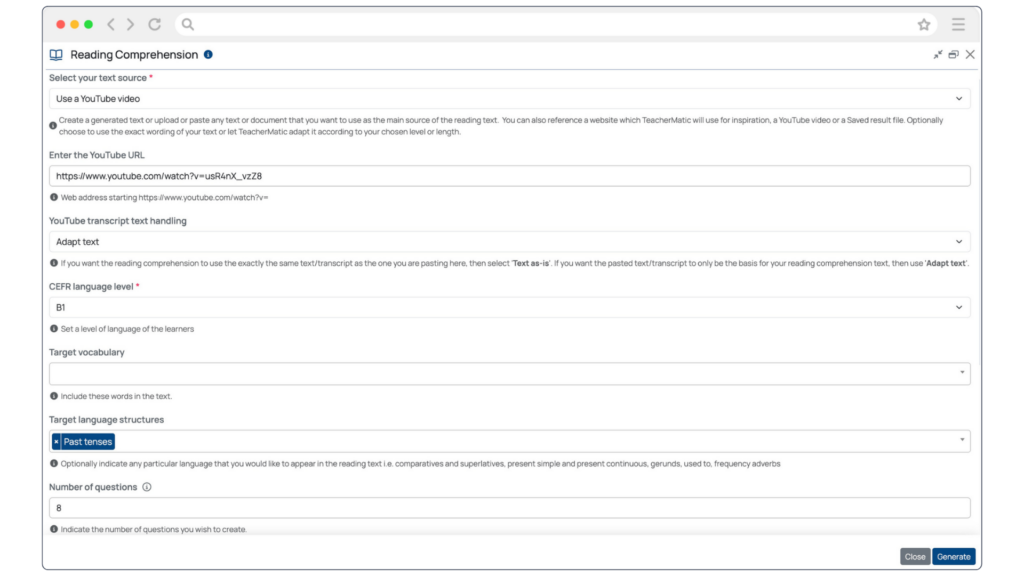
Pilar demonstrated how to transform authentic content into engaging, CEFR-aligned reading activities in just a few steps. Using a YouTube video about the World Cup hydration breaks, she showed how teachers can incorporate current affairs, popular culture and other timely topics into their lessons, helping make lessons or activities more relevant and engaging for learners.

Reading comprehension generator showing inputs including YouTube video link, B1 CEFR level and past tense.

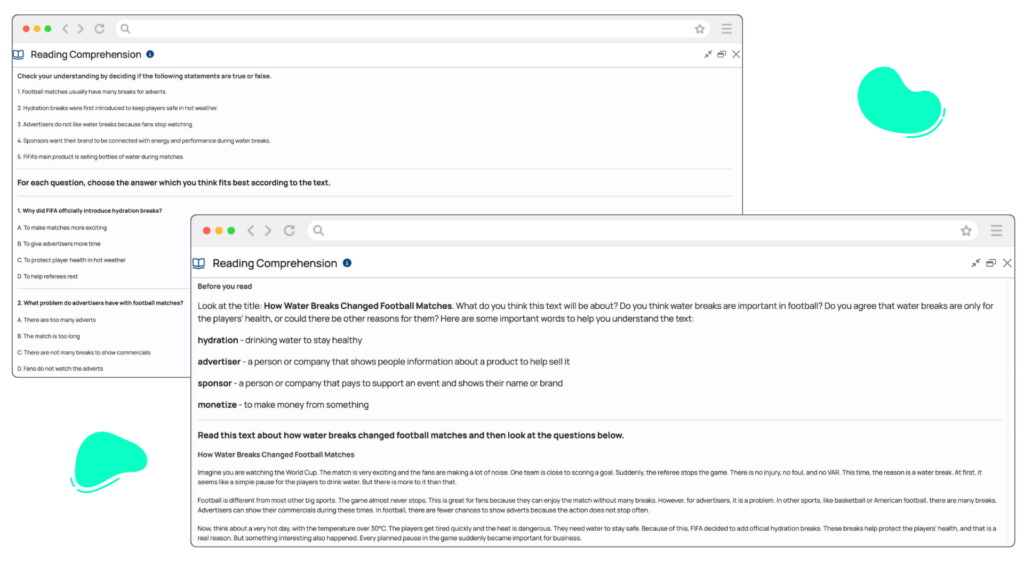
Teachers can create materials from a range of sources, including uploaded documents, pasted text, content generated within TeacherMatic or online videos. For this example, Pilar adapted the source material for B1 learners, focused on the past tense and selected additional activities to support learners before, during and after reading. These included pre-reading tasks to introduce the topic, a glossary learners could use independently to check unfamiliar vocabulary, true-or-false questions to monitor understanding and further activities to extend practice beyond the text.

Together, these activities created a complete reading lesson built around a single authentic source. Teachers can refine the output, adjust formatting, regenerate activities and tailor every resource to suit their learners, lesson objectives and teaching style.

Reading Comprehension generator output. This includes an explanation paragraph, reading text and multiple-choice questions.

Building Connected Grammar Practice

Teachers can reuse the reading comprehension activity they have already created to generate a connected open cloze exercise. By building on the same content source, they can reinforce grammar while keeping every activity connected to the original topic and context.

Using the ‘Open Cloze’ generator, Pilar created a B1-level activity complete with clear instructions, worked examples and an answer key. As TeacherMatic is purpose-built for language teaching, teachers do not need to write complex prompts or become prompt engineering experts to create tailored, high-quality teaching resources.

Open Cloze generator output. This includes key vocabulary students should use and the open cloze activity paragraph.

Pilar also demonstrated how teachers can tailor activities to focus on specific language points. Instead of creating a general open cloze exercise, they can refine the output to target particular grammatical features, such as prepositions, pronouns or nouns, helping learners practise the language they need to develop.

Reinforcing Vocabulary Through Contextualised Practice

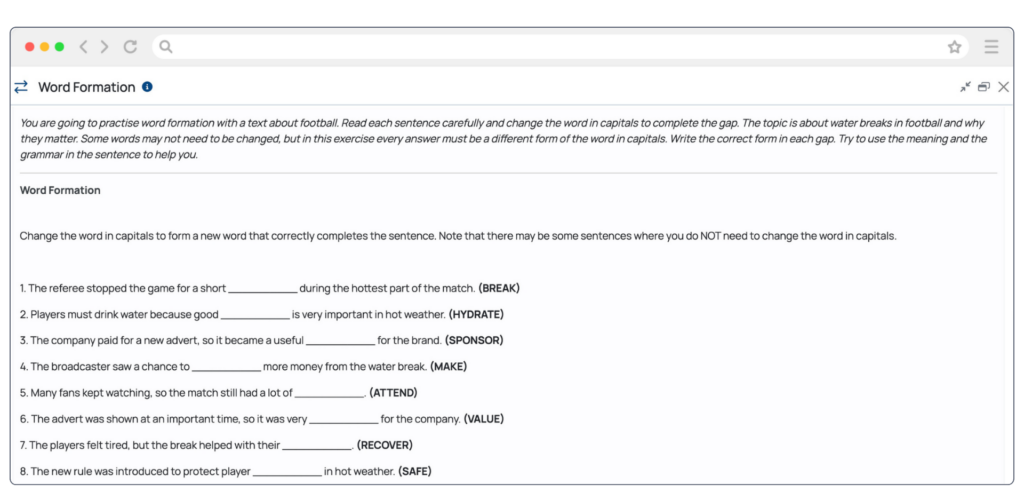
Pilar’s final demonstration showed how language educators can continue to build on previously created resources to produce word formation activities that reinforce vocabulary in a familiar context. The ‘Word Formation’ generator begins at the B1 level, because these activities are most appropriate for learners working at this level and above. The generator does not offer A1 or A2 as selectable CEFR levels, ensuring activities align with learners’ expected language development.

Refine, Organise and Reuse Your Teaching Materials

Every TeacherMatic AI generator is designed to support, not replace, teachers’ professional judgement. Whether creating reading activities, grammar exercises or vocabulary practice, teachers can review and refine every output to suit their learners, lesson objectives and teaching context.

Pilar also explained how resources can be regenerated to provide fresh ideas or alternative approaches, helping teachers explore different ways to present the same language focus. Simple refinements, such as improving formatting and readability, can make activities clearer and more accessible for learners.

One of Pilar’s favourite TeacherMatic features is the ability to save, organise and revisit generated resources. Activities can be grouped into folders, previewed and exported in formats such as PDF or Word, or shared directly with learners through platforms such as Google Classroom. Resources can also be shared with colleagues, making it easier to collaborate, reuse effective materials and build a growing library of teaching resources over time.

Supporting Every Stage of Lesson Preparation

By the end of the session, Pilar had demonstrated how TeacherMatic supports teachers from initial lesson planning through to the creation and refinement of connected classroom materials. Starting with a single authentic source, she used safe, purpose-built AI tools to create CEFR-aligned reading, grammar and vocabulary activities that help learners improve comprehension, practise grammar and develop vocabulary.

Rather than relying on complex prompts, Pilar was able to personalise every activity for her learners, refine and modify the outputs and review each resource before use. In just a few minutes, she had created a complete lesson tailored to her teaching objectives and learner needs, supporting learners in building language confidence and preparing them for real-world communication.

Explore the TeacherMatic Language Teaching Edition

The TeacherMatic Language Teaching Edition provides practical, safe AI tools that help language educators create CEFR-aligned materials supporting reading comprehension, vocabulary development and grammar practice. Teachers remain in control of every step, reviewing and refining outputs to meet the needs of their learners and teaching context.

Next in the Webinar Series

After a short summer break, join award-winning educator and edtech specialist Nik Peachey for the next session in the Language Teaching Takeoff Webinar Series.

Nik will share practical ideas and strategies that you can apply immediately to support your learners’ language development. You’ll also discover new ways to make the most of the TeacherMatic Language Teaching Edition in your everyday teaching.

🗓 Thursday, 17th September

🕛 12:00 – 12:30 BST (13:00 – 13:30 CEST)


About Avallain

For more than two decades, Avallain has enabled publishers, institutions and educators to create and deliver world-class digital education products and programmes. Our award-winning solutions include Avallain Author, an AI-powered authoring tool, Avallain Magnet, a peerless LMS with integrated AI, and TeacherMatic, a ready-to-use AI toolkit created for and refined by educators.

Our technology meets the highest standards with accessibility and human-centred design at its core. Through Avallain Intelligence, our framework for the responsible use of AI in education, we empower our clients to unlock AI’s full potential, applied ethically and safely. Avallain is ISO/IEC 27001:2022 and SOC 2 Type 2 certified and a participant in the United Nations Global Compact.

Contact:

Daniel Seuling

VP Client Relations & Marketing
dseuling@avallain.com