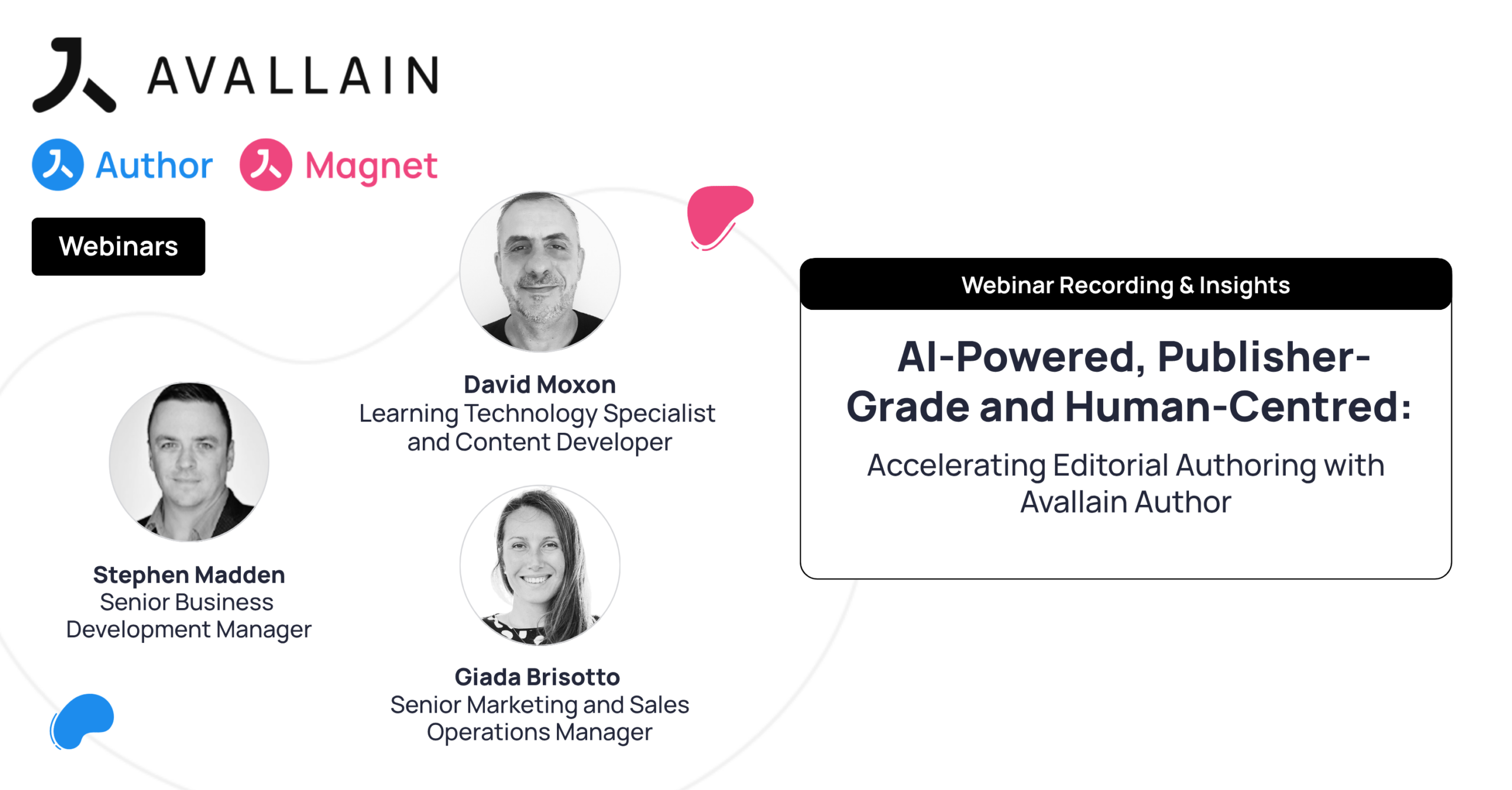
AI-Powered, Publisher-Grade and Human-Centred: Accelerating Editorial Authoring with Avallain Author

Creating high-quality digital learning content at scale requires efficient editorial workflows that support both productivity and human oversight. In the third session of Avallain’s Product Webinar Series, David Moxon and Stephen Madden explored how Avallain Author supports publishers, schools, institutions and digital learning providers in accelerating editorial production while creating interactive, responsive and accessible learning content across a wide range of educational contexts.

AI-Powered, Publisher-Grade and Human-Centred: Accelerating Editorial Authoring with Avallain Author

St. Gallen, August 2026 –In the third session of Avallain’s Product Webinar Series, ‘AI-Powered, Publisher-Grade and Human-Centred: Accelerating Editorial Authoring with Avallain Author’, David Moxon, Learning Technology Specialist and Content Developer, and Stephen Madden, Senior Business Development Manager, demonstrated how Avallain Author combines content creation and management with AI-powered capabilities to support efficient, publisher-grade editorial workflows.

Moderated by Giada Brisotto, Senior Marketing and Sales Operations Manager, the webinar explored how editorial teams can manage complex content projects, accelerate the creation of learning materials with AI and build highly interactive, responsive and accessible educational experiences for different sectors and learner needs.

Managing Content and Editorial Workflows in One Environment

The webinar opened with a live demonstration of Avallain Author from Stephen, who introduced the platform not only as a content creation tool, but also as a content management environment designed to support structured editorial production.

From the project dashboard, teams can gain an overview of the people working on a project, assigned tasks and different editorial roles. Roles can be configured with specific rights and permissions, helping organisations establish workflows that reflect the way their teams work.

Stephen also introduced the different areas available within a project, including Work Packages, Structures, the Media Library, Reports, Project Settings and Project Activities. Together, these capabilities provide a central environment for creating, organising and managing learning content throughout the production process.

Within Work Packages, teams can manage individual Learning Objects (LOs) and perform actions individually or in bulk, including publishing, copying, renaming and locking content. Metadata can also be added to learning activities, supporting richer analysis once learners begin interacting with the content by categorising it according to areas such as vocabulary, grammar or speaking.

By bringing content production and project management together, Avallain Author enables editorial teams to manage sophisticated digital learning projects without separating the creation process from the workflows surrounding it.

Accelerating Content Creation with AI While Keeping Humans in the Loop

Stephen then demonstrated GenAI in Avallain Author, showing how artificial intelligence can accelerate the first stages of content production without removing editorial control.

Starting with a simple prompt around small talk in a business context, he created a B1-level lesson for adult language learners. The learner profile allowed parameters such as age and CEFR level to be defined, while the author could choose the types of activities to generate and incorporate media where required.

For the demonstration, GenAI created four activities: an introductory presentation, a gap-fill exercise, a linking activity and a crossword. Within approximately a minute, the initial idea was transformed into a structured set of interactive learning activities ready for review and refinement.

Crucially, the workflow did not end with AI generation.

Stephen demonstrated how an editor could immediately review the generated material and make precise changes, whether to align terminology with an editorial style guide, reinforce previously introduced vocabulary or adapt the material to the requirements of a particular course.

This reflected one of the webinar’s central themes: AI can significantly accelerate drafting and production, but human editorial expertise remains essential. Rather than automatically publishing AI-generated material to learners, Avallain Author allows authors and editors to review, adapt and approve content before it reaches the learner.

The Q&A reinforced this approach. The speakers explained that generated content undergoes an initial check for harmful or highly inappropriate material, while editorial validation remains dependent on human review. This human-in-the-loop principle forms an important part of Avallain’s wider approach to the responsible use of AI in education.

Creating Interactive Learning Experiences Across Educational Contexts

David continued the live demonstration by showcasing the breadth of interactive learning content that can be created in Avallain Author.

With more than 50 Activity Types available, Avallain Author supports learning experiences designed for a wide variety of educational contexts rather than limiting authors to a small set of standard interactions.

For language learning, David demonstrated a Dialogue Recording activity in which learners can select a role within a conversation, listen to the other speaker and record their own responses. Once complete, learners can listen back to the entire dialogue, combining the original audio with their own recorded contributions.

He also demonstrated a Pronunciation activity that enables learners to record individual words and receive automated pronunciation feedback. Authors can adjust how feedback is presented and define the level at which pronunciation is considered successful, making the activity adaptable to different learner levels and objectives.

The demonstration then moved across other educational sectors. A K-12 activity used animated elements to help learners sequence the stages of the water cycle, while a STEM example showed how integration with WIRIS enables learners to work with sophisticated mathematical notation, equations and mathematical input.

For vocational learning, a Highlighting activity asked learners to identify different categories of safety information within a workplace procedure.

Together, the examples illustrated how a common authoring environment can support very different pedagogical requirements, from speaking practice and pronunciation to mathematics, sequencing and workplace training.

Responsive and Accessible Learning by Design

The webinar also highlighted how responsiveness and accessibility are embedded into the learning experiences created with Avallain Author.

During the demonstrations, attendees saw how content could be previewed across different device formats, including desktop, tablet and mobile. Activity Types adapt automatically to different screen sizes and, where necessary, can adjust their behaviour to provide an appropriate interaction for the device being used.

This means editorial teams do not need to create separate versions of the same learning activity for different devices.

David also highlighted accessibility across Avallain Author’s Activity Types, including support for screen readers and keyboard navigation. By incorporating these considerations into the content framework itself, publishers and educational organisations can create engaging digital materials while addressing accessibility requirements as an integral part of the production process.

From Digital Books to Richer Learning Experiences

The session concluded with a preview of Avallain Author’s Digital Book capabilities.

David demonstrated how existing PDF materials can be imported into Avallain Author and transformed into a Digital Book that retains the familiar book experience while introducing new layers of interactivity.

Learners can navigate the book, use annotation tools and interact with hotspots placed directly onto its pages. These hotspots can connect the book to interactive Learning Objects, video and audio content, external websites and other pages within the publication.

This approach enables publishers to build on existing book-based materials while connecting them with interactive digital learning experiences, bridging traditional publishing formats and richer course-based learning.

Digital Books and the wider Digital Book Experience will be explored in greater depth in the next session of Avallain’s Product Webinar Series.

Combining Editorial Efficiency with Human Expertise

The webinar demonstrated how Avallain Author brings together the different elements required for modern digital educational publishing: project and content management, AI-assisted creation, sophisticated interactivity, responsive delivery and accessibility.

AI can help editorial teams move rapidly from an initial idea to a first draft of structured learning content. A broad range of Activity Types allows those materials to be transformed into engaging experiences for language learning, K-12, STEM, vocational training and other educational contexts. At the same time, project management and editorial capabilities enable teams to organise, review and control content throughout production.

Most importantly, automation does not replace editorial judgement. Authors and editors remain responsible for reviewing generated content, applying their pedagogical and subject expertise and deciding when materials are ready to be published.

By combining AI-powered efficiency with publisher-grade workflows and human oversight, Avallain Author enables organisations to accelerate digital content production while maintaining the quality, flexibility and control required to create meaningful learning experiences at scale.

Watch the Webinar Recording

Watch the full webinar recording to see Avallain Author in action and discover how its project management, AI-powered content creation and interactive Activity Types can help editorial teams accelerate production while keeping human expertise at the centre of the authoring process.

Continue the Conversation in Our Next Webinar

Our Product Webinar Series continues with the next live session:

Digital Book Experience Courses: Seamlessly Connecting Traditional Books and Interactive Activities with Avallain Author and Avallain Magnet

Hosted by:

  • David Moxon, Learning Technology Specialist and Content Developer, Avallain
  • Stephen Madden, Senior Business Development Manager, Avallain

Moderated by:

  • Giada Brisotto, Senior Marketing and Sales Operations Manager, Avallain

🗓 Wednesday, 23 September 2026
🕒 14:00–14:30 BST | 15:00–15:30 CEST

Through more than two decades of close collaboration with publishers, we’ve seen how digital books have become the backbone of many successful product strategies. In this 30-minute live webinar, we will share innovative ways to enhance these offerings, both commercially and in ways that enrich the learner’s journey.

Go beyond simply delivering books online and expand them into an immersive learning experience with fully interactive activities connected to the book’s material. We will demonstrate how to enhance digital books with Avallain Author and Avallain Magnet. You’ll learn how to add interactive hotspots seamlessly connected to multimedia assets and learning exercises, develop a comprehensive course structure and provide an engaging Digital Book Experience (DBX) course for your learners.

We will guide you through the process of creating a Digital Book from PDF materials in Avallain Author. We’ll show you how to integrate interactive elements via hotspots, organise the DBX course with the Structure Tool and publish it to showcase the final learner experience in Avallain Magnet.

Click below to register and secure your spot.


About Avallain

For more than two decades, Avallain has enabled publishers, institutions and educators to create and deliver world-class digital education products and programmes. Our award-winning solutions include Avallain Author, an AI-powered authoring tool, Avallain Magnet, a peerless LMS with integrated AI, and TeacherMatic, a ready-to-use AI toolkit created for and refined by educators.

Our technology meets the highest standards with accessibility and human-centred design at its core. Through Avallain Intelligence, our framework for the responsible use of AI in education, we empower our clients to unlock AI’s full potential, applied ethically and safely. Avallain is ISO/IEC 27001:2022 and SOC 2 Type 2 certified and a participant in the United Nations Global Compact.

Contact:

Daniel Seuling

VP Client Relations & Marketing

dseuling@avallain.com

Riverstone Press Launches Studio in Spain, Powered by Avallain

A new English learning proposition brings together high-quality educational content and a connected digital experience ahead of the new school year. Riverstone Press launches Studio, powered by Avallain, building on a long-standing collaboration to create intuitive digital learning experiences for teachers and students.

Riverstone Press Launches Studio in Spain, Powered by Avallain

Madrid, August 2026 — Riverstone Press is preparing for the start of the new academic year with the launch of Studio, its digital learning environment powered by the same technology as Avallain Magnet, Avallain’s peerless, AI-enhanced learning management system.

The launch marks an important milestone as Riverstone Press brings its English language learning proposition to schools across Spain, with classes beginning in September 2026.

At the heart of the Riverstone Press experience, Studio connects teachers and students with the digital content and resources that accompany their programmes, creating a more integrated journey between classroom materials and digital learning.

Rather than positioning technology as an add-on, Riverstone Press has incorporated Studio as a core part of its educational proposition: one environment where teachers can access programme resources and students can engage with content connected to their courses throughout the academic year.

One Connected Experience for Teaching and Learning

Studio combines course materials, interactive activities, digital books and multimedia resources within a centralised environment designed to make the experience easier to navigate for both teachers and learners.

For teachers, this means having the resources associated with their programmes available within one digital space, helping them move more naturally between planning, classroom instruction and digital activities.

For students, Studio provides continuity beyond the printed page, giving them access to digital content and interactive learning experiences connected to the programme they are using in class.

This approach reflects Riverstone Press’s broader vision: combining strong English language learning content with practical resources and technology that can support schools throughout the learning journey.

Riverstone Press, Built for a New Market

Riverstone Press has been developed as an English language learning proposition designed around the needs of schools, teachers and learners at different stages of education.

Its arrival in the market goes beyond the introduction of new course materials. The proposition integrates print and digital content, plus supporting resources, in a connected ecosystem designed around the needs of schools, teachers and learners.

Studio plays a central role in that ecosystem.

By providing the digital environment behind the programmes, Studio helps Riverstone Press deliver a more consistent experience across its educational offering and gives schools a single point of access to the digital resources that support classroom implementation.

‘The launch of Riverstone Press and Studio in Spain represents an important new step in our digital strategy. We wanted to create an educational proposition in which high-quality content and technology work together naturally, giving schools and teachers meaningful evidence of student learning and progress, while providing students with a more connected experience from the beginning of the new academic year,’ said Esdras Taylor, Santillana Languages Global Managing Director.

Powered by a Long-Standing Technology Partnership

The launch of Studio also builds on a long-standing collaboration with Avallain, a leading provider of edtech solutions.

For more than a decade, Avallain and Richmond have worked together to develop and deliver digital English language learning experiences. That collaboration has included using Avallain technology to create, manage and distribute interactive ELT content through flexible digital environments.

Studio represents the latest evolution of that experience, bringing Avallain’s platform technology into Riverstone Press and supporting a new generation of connected learning experiences.

The result is a digital environment designed to support a broad range of educational content while providing the flexibility needed to accompany the evolution of programmes, resources and classroom needs over time.

‘Bringing Studio to Spain as part of the Riverstone Press launch is an exciting new chapter in our collaboration. It is a strong example of how technology and high-quality educational content can come together to create a digital experience that is useful, intuitive and relevant for teachers and learners’, said Alexis Walter, Managing Director of Avallain.

Ready for the New School Year

As the new academic year begins, Riverstone Press and Studio will start supporting schools, teachers and students through a connected learning experience.

The launch encompasses a new educational brand, English language learning programmes and a digital environment designed to connect content, resources and users in one experience.

For Riverstone Press, Studio is not simply the platform behind the programmes. It is an essential part of how the brand intends to support teaching and learning: combining content, technology and classroom practice in a way that is accessible, connected and future-ready. The environment has been designed to evolve with emerging technologies, including the integration of AI capabilities, while responding to the new challenges shaping both education and digital learning.


About Riverstone Press

Riverstone Press is an English language learning proposition developed for schools, teachers and learners in Spain. It offers programmes, print and digital resources, and classroom support designed for different stages of education.

Its approach brings together educational content and technology to create connected learning experiences that support both teaching and student progress. Studio, powered by Avallain, serves as the digital environment supporting Riverstone Press programmes and connecting users with the resources associated with their learning experience.

About Avallain

For more than two decades, Avallain has enabled publishers, institutions and educators to create and deliver world-class digital education products and programmes. Our award-winning solutions include Avallain Author, an AI-powered authoring tool, Avallain Magnet, a peerless LMS with integrated AI, and TeacherMatic, a ready-to-use AI toolkit created for and refined by educators.

Our technology meets the highest standards with accessibility and human-centred design at its core. Through Avallain Intelligence, our framework for the responsible use of AI in education, we empower our clients to unlock AI’s full potential, applied ethically and safely. Avallain is ISO/IEC 27001:2022 and SOC 2 Type 2 certified and a participant in the United Nations Global Compact.

Contact:

Daniel Seuling

VP Client Relations & Marketing

dseuling@avallain.com

Preserving Human Agency in AI-Driven Digital Education Environments

In this article, Carles Vidal, Business Director of the Avallain Lab, explores the importance of human agency and oversight in AI-driven digital environments. He considers what these principles mean for educators, learners, educational institutions and edtech providers and how they are reflected in the current AI regulation. He also examines why human judgement, choice and control should remain essential to designing technology as AI takes on a greater role in education.

Preserving Human Agency in AI-Driven Digital Education Environments

From regulation to product design: keeping users in control

Author: Carles Vidal, MSc in Digital Education, Business Director of the Avallain Lab

St. Gallen, August 24, 2026 – One direct consequence of the current integration of artificial intelligence (AI) in educational software is the surge of AI-driven features designed to assist teachers, students and administrators across a range of key educational tasks. These tools are used to generate personalised content, automate feedback and assessment, provide guidance and report on students’ performance, to name a few, all aimed at reducing workload and augmenting users’ productivity in digital education environments. 

Educational institutions demand these kinds of capabilities, and edtech companies are delivering them in multiple ways. From an AI ethics perspective, however, implementing AI-based automation features may compromise core tenets of trustworthy AI: human agency and human oversight. In education, these principles mean keeping educators as the final pedagogical authority on the platform while ensuring students can make informed decisions throughout their learning journey. The challenge for the sector is to design tools that fully preserve human agency while meeting the demand for greater AI-driven system autonomy.

Human Agency and Human Oversight

To understand what these principles mean, it is worth examining two relevant sources: the Council of Europe Framework Convention on Artificial Intelligence and Human Rights, Democracy and the Rule of Law (signed in 2024 and not yet ratified), which aims to set an international standard to protect fundamental rights throughout the AI lifecycle, and the European Union Artificial Intelligence Act (2024), which addresses these principles in the context of a binding legal and technical regulation within the EU market.

From a human rights perspective, the Council of Europe calls on states to protect human dignity, individual autonomy and transparency throughout the AI lifecycle: from its design to its implementation (articles 7 and 8). The framework establishes that individuals must retain self-determination, requiring adequate oversight so users can understand, oversee and challenge automated systems.

In turn, from a regulatory perspective, the EU AI Act recognises human agency and oversight in Recital 27 and Article 14 as key requirements for trustworthy AI. Drawing on the High-Level Expert Group’s Ethics Guidelines (2019), human agency implies that users should be able to make informed, autonomous decisions when interacting with AI systems, and critical to this concept is the right of the individuals not to be subject to a decision based solely on automated processing, when this produces legal effects on users or similarly significantly affects them. Article 14 translates human oversight into actionable regulation by establishing that high-risk AI systems must feature human-machine interface tools that allow persons to oversee, interpret and override automated outputs in real time.

Together, these frameworks define human agency as a key requirement to ensure the users’ right to be autonomous decision makers, and human oversight as a range of technical safeguards to achieve this end. 

User Agency in Digital Educational Environments

In the context of educational software, it is important to keep in mind that the EU AI Act regulates AI-driven features, not traditional automation tools that have been on the market for years. Specifically, the Act focuses on ‘machine-based systems’ able to generate ‘predictions, content, recommendations, or decisions that can influence physical or virtual environments’ (Article 3.1). Therefore, common features like pre-defined adaptive pathways or assessment based on standard scoring fall outside the regulation, as they do not rely on AI. 

For those edtech companies whose software, or a particular feature of it, falls under the scope of the EU AI Act, these principles have direct regulatory consequences. In this sense, Annex III of the EU AI Act establishes that AI systems that evaluate learning outcomes, assess the appropriate level of education or determine access to educational institutions are classified as high-risk, (except if they ‘do not pose significant risk of harm to the health, safety or fundamental rights of natural persons, including by not materially influencing the outcome of decision-making’ (Article 6.3)). When the exception does not apply, Article 14 requires software providers to build technical oversight controls directly into the user interface, such as review dashboards, score override options, output explainability tools and system stop controls so educators can validate or override AI suggestions.  

At a practical level, this means that, for example, an AI feature able to decide if students progress to the next academic year would be classified as high-risk, since it directly determines a critical educational outcome for users. In this case, the software provider must implement oversight measures that allow educators/administrators to review, override or cancel the system’s decisions. 

In contrast, an AI chatbot that suggests optional study resources to students, in accordance with the student’s performance, and that students can ignore, should not be considered high-risk, as it does not dictate any decision affecting those users. Therefore, no oversight measures would be required in this case, although even in lower-risk scenarios, user agency can also be supported by making AI interactions transparent or allowing users to disable recommendations.

These two examples illustrate clear risk classification cases and their corresponding mitigating strategies. In practice, following the same logic, software providers need to assess their AI-based features, determine their risk category and implement the appropriate oversight controls or transparency safeguards.

User Agency in Practice: From Principles to Product Design

How can these principles be promoted throughout the lifecycle of digital educational environments? In our research-based report, From the Ground Up (2025), a set of 12 core controls was identified as critical to ensure the ethical use of AI in education. Among these controls, the document recommends User Agency Preservation, which involves designing AI systems that empower teachers and students with choice and control, ensuring that AI in education does not undermine student autonomy or teachers’ professional judgement.

This principle operates at two levels:

  • For educators: Ensuring AI acts as a supportive assistant rather than an autocratic system, preserving the educator’s professional decision-making authority.
  • For students: Providing meaningful options to shape their learning process, such as setting personal goals, choosing between learning modalities or overriding AI recommendations when appropriate.

The degree to which students exercise their agency will depend on age and context; for younger learners, educators and guardians may carry out this responsibility by overseeing AI interactions on their behalf.

Avallain’s Approach

At Avallain, these principles form the foundation of Avallain Intelligence, our strategy for the responsible use of AI in education, with ethics and safety at the core. This informs the design of AI features and tools across our product suite. AI-powered capabilities in Avallain Author and Avallain Magnet, alongside the TeacherMatic AI toolkit, are built to support publishers, institutions, content authors and educators with tasks such as drafting content, generating ideas, creating practice activities and improving productivity in content creation and planning. In all cases, AI outputs are positioned as a starting point rather than a finished product. Professional review, adaptation and validation remain essential steps before content reaches learners.

This design philosophy has direct consequences for risk classification. Avallain’s AI features are deliberately designed to preserve human agency and oversight, an approach that avoids high-risk categorisation under the EU AI Act. AI does not determine final grades, progression, certification or learner outcomes. It does not make autonomous educational decisions or assess learners without human involvement. By ensuring that AI outputs are always mediated or supervised by qualified professionals, the software supports assistance and safeguards decision-making.

Human agency is also fostered through transparency and user control. AI features are clearly presented as assistive tools, not as authoritative sources. Users are informed when AI is being used and are encouraged to understand that AI-generated output is probabilistic, may contain errors and requires review. 

Conclusion

The integration of AI in educational software presents real opportunities to reduce workload and support productivity across publishers and educational institutions. However, these benefits must not come at the expense of human agency and oversight: the authority of educators to make final pedagogical decisions and the right of learners to remain autonomous actors in their own education. 

International frameworks and European regulation recognise and implement these principles, and responsible product design must respond accordingly. The challenge for edtech providers is to harness the potential that AI systems can deliver while ensuring that educators and learners remain at the centre of every decision. At Avallain, this is the approach we have chosen: AI as a transparent, controllable support layer, always subject to human judgement.


About Avallain

For more than two decades, Avallain has enabled publishers, institutions and educators to create and deliver world-class digital education products and programmes. Our award-winning solutions include Avallain Author, an AI-powered authoring tool, Avallain Magnet, a peerless LMS with integrated AI, and TeacherMatic, a ready-to-use AI toolkit created for and refined by educators.

Our technology meets the highest standards with accessibility and human-centred design at its core. Through Avallain Intelligence, our framework for the responsible use of AI in education, we empower our clients to unlock AI’s full potential, applied ethically and safely. Avallain is ISO/IEC 27001:2022 and SOC 2 Type 2 certified and a participant in the United Nations Global Compact.

Find out more at avallain.com

_

Contact:

Daniel Seuling

VP Client Relations & Marketing
dseuling@avallain.com

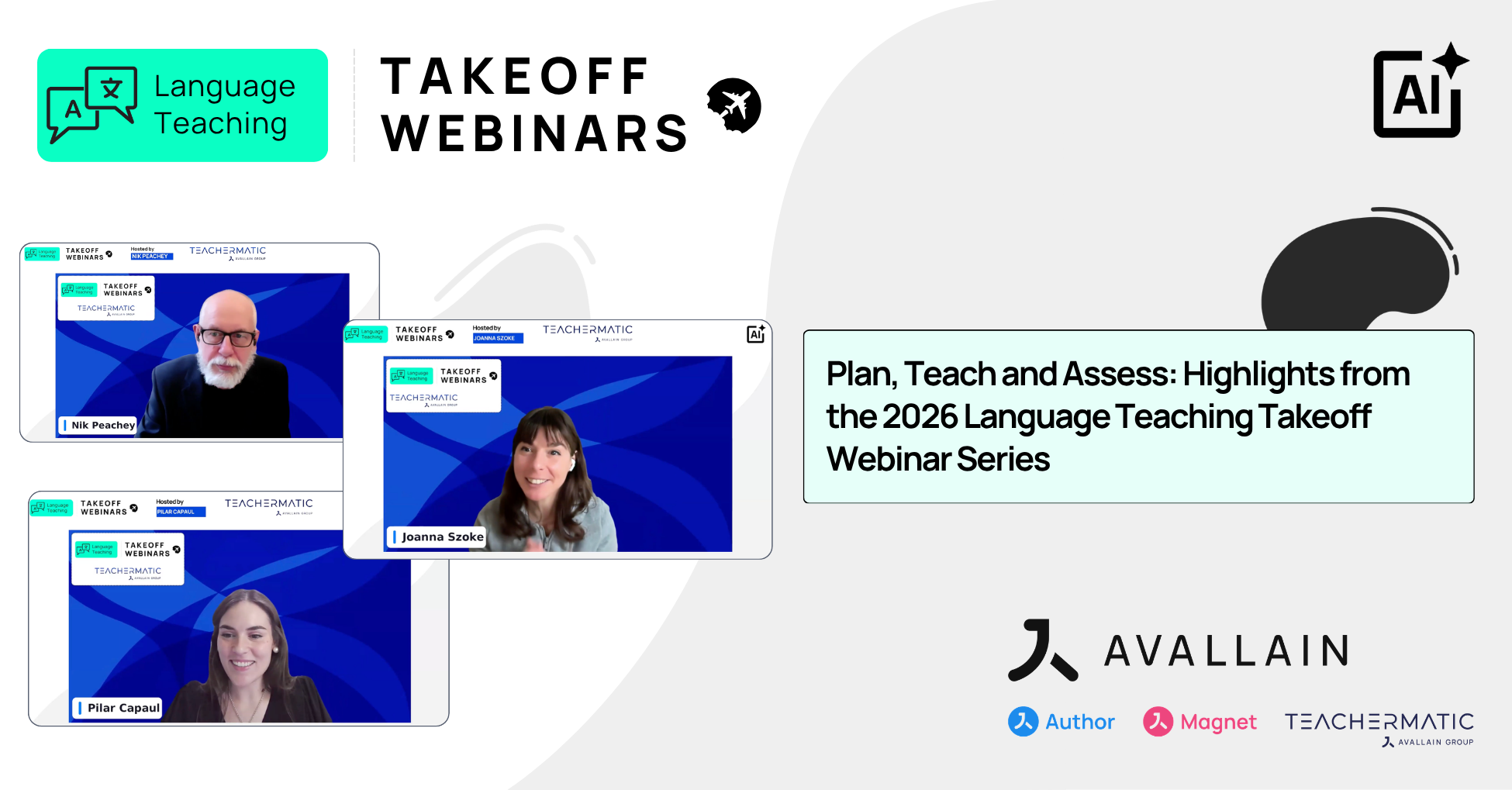
Plan, Teach and Assess: Highlights from the 2026 Language Teaching Takeoff Webinar Series

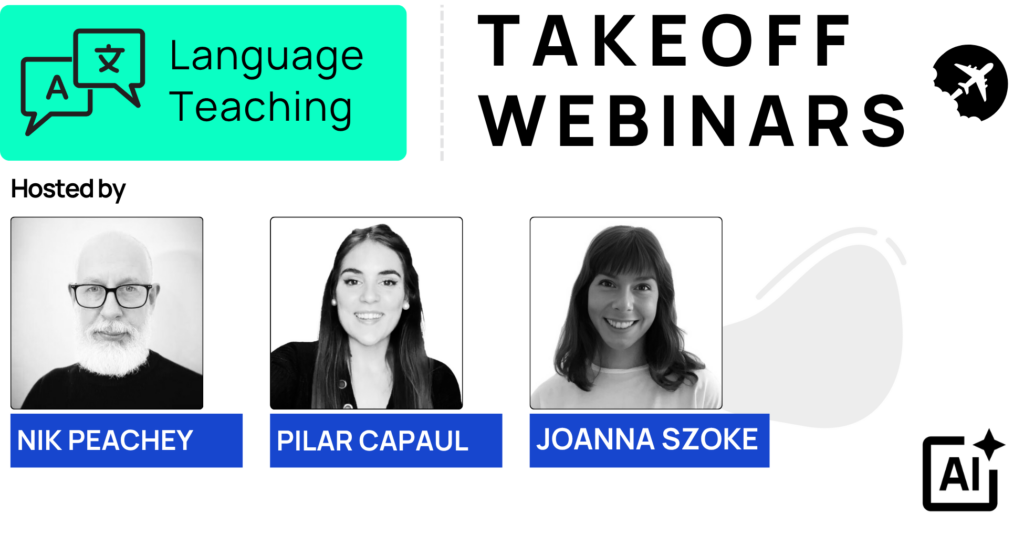
Throughout the first half of 2026, the Language Teaching Takeoff Webinar Series has brought together three language teaching experts to explore how TeacherMatic can support every stage of language teaching, from planning and lesson preparation to classroom engagement, assessment and feedback. This blog revisits the highlights from the series so far, exploring the key ideas, teaching strategies and webinar recordings.

Plan, Teach and Assess: Highlights from the 2026 Language Teaching Takeoff Webinar Series

London, August 2026 – Across the series, each host draws on their own area of expertise to demonstrate how TeacherMatic can be applied in different contexts. Attendees discover practical strategies, explore purpose-built AI generators and learn how to integrate AI meaningfully and responsibly into planning, teaching and assessment while maintaining full pedagogical control.

Designed specifically for language teaching, the TeacherMatic Language Teaching Edition enables language educators to generate comprehensive schemes of work, adapt content for different CEFR levels, provide meaningful feedback, create engaging exam practice, inspire students and much more.

Since the series began, more than 900 educators have joined the webinar series to explore responsible AI in language education and discover practical ways to support confident language learners with TeacherMatic.

Meet the Hosts

The expertise behind the Language Teaching Takeoff Webinar Series is what makes each session valuable. Combining experience across language teaching, educational technology, teacher training and content creation, our hosts share their knowledge, practical insights and passion for improving language teaching through thoughtful use of technology.

Nik Peachey is an award-winning educator, author and edtech specialist with extensive experience in digital learning, teacher development and pedagogical innovation. He offers strategic perspectives on course development, lesson planning, CEFR alignment and the effective use of technology in education.

Everyday classroom experience is brought to the series by Pilar Capaul. As a language teacher and ELT content creator, she shares practical strategies drawn from her own teaching practice and experience creating engaging resources for language learners.

Joanna Szoke is a freelance teacher trainer and AI in education specialist with a particular focus on assessment, feedback, exam preparation and responsible AI adoption. Her work centres on creating meaningful assessment experiences and exploring how emerging technologies can genuinely support educators in the classroom.

The sessions are moderated by Giada Brisotto, Senior Marketing and Sales Operations Manager, and Alba Melián, Marketing and Sales Operations Consultant, who use their own language teaching experience to guide thoughtful discussions and connect ideas across each session.

Plan, Prepare and Make Informed CEFR Decisions

Nik Peachey has focused his sessions this year on effective planning and informed CEFR alignment, demonstrating how educators can combine their professional knowledge with purpose-built AI tools.

Plan Smarter and Teach with Confidence

In Plan Smarter and Teach with Confidence, Nik demonstrated how teachers, academic managers and directors of studies can use TeacherMatic’s AI generators, including ‘Scheme of Work / Curriculum’, to support different stages of course and lesson planning. 

Highlights included how to:

  • Create structured schemes of work around learner needs, course aims and pedagogical approaches.
  • Develop CEFR-aligned lesson plans from individual sessions.
  • Create purposeful lesson wrap-ups to reinforce learning and reflection.

Make Informed CEFR Alignment Decisions in the Age of AI

CEFR alignment has been a key focus for Nik this year. In Make Informed CEFR Alignment Decisions in the Age of AI, he explored how a deeper understanding of the framework can empower educators to make more informed decisions when creating and adapting materials with AI.

Nik introduced the free CEFR Alignment for Teachers: In the Age of AI course, developed in collaboration with the Norwich Institute for Language Education (NILE). He further demonstrated how educators can put these principles into practice with TeacherMatic.

Key takeaways included:

  • Understanding what meaningful CEFR alignment involves, beyond simply assigning content an A1 to C2 level.
  • Applying professional judgement when creating and evaluating AI-generated materials.
  • Creating and adapting content for different CEFR levels and learner needs using the  ‘Create a Text’ and ‘Adapt your Content’ generators. 
  • Using the ‘CEFR Level Checker’ to review materials and inform further adaptation.

Teach, Inspire and Create Engaging Learning Experiences

Pilar Capaul has brought an everyday classroom perspective to the series, sharing practical ways to create engaging activities, monitor understanding and adapt materials around the needs and interests of learners.

Inspire, Monitor, Motivate: Practical AI Tools for Everyday Teaching

In Inspire, Monitor, Motivate: Practical AI Tools for Everyday Teaching, Pilar drew on examples from her own lessons to demonstrate how TeacherMatic can empower educators to respond to everyday classroom challenges. 

Highlights included how to:

  • Turn homework checks into engaging warm-up activities with the ‘Did you do your homework?’ generator, helping educators check comprehension and identify areas to revisit.
  • Generate fresh ideas with the ‘Inspiration!’ generator to make familiar or less engaging topics more motivating.
  • Adapt activities around different learner profiles, levels and teaching approaches.

Reading, Vocabulary and Grammar: Practical AI Tools for Everyday Language Teaching

In July, Pilar continued this practical classroom focus in Reading, Vocabulary and Grammar: Practical AI Tools for Everyday Language Teaching. Using the ‘Reading Comprehension’, ‘Open Cloze’ and ‘Word Formation’ generators, she demonstrated how educators can create connected, CEFR-aligned activities around authentic content, tailoring each resource to their learners and lesson objectives.

Key takeaways included:

  • Bringing authentic content into lessons by turning sources such as online videos into relevant, CEFR-aligned reading activities.
  • Building grammar and vocabulary practice around the same source material to create a more cohesive learning experience.
  • Refining materials around specific CEFR levels, learner needs, language points, lesson objectives and teaching contexts.
  • Creating a reusable library of resources. Save, organise, adapt and share generated materials for future lessons.

Prepare, Assess and Provide Meaningful Feedback

Joanna Szoke has focused on assessment, feedback and exam preparation throughout the series, exploring how educators can support learner progress and confidence with AI.

Create Dynamic and Engaging Exam Practice for Your Students

In Create Dynamic and Engaging Exam Practice for Your Students, Joanna explored how assessment and exam preparation can become opportunities for learning, rather than simply measuring performance. 

Highlights included how to:

  • Create targeted Cambridge-style exam practice for different levels with the ‘Cambridge Style Exam Prep Generator’.
  • Connect exam activities with real-life language use and learner interests.
  • Develop adaptable worksheets and practice materials with the ‘Worksheet’ generator to address specific learner needs.

Provide Meaningful, Timely Feedback at Scale with the Power of AI

Providing meaningful feedback is a particular passion for Joanna. In Provide Meaningful, Timely Feedback at Scale with the Power of AI, she explored what makes feedback genuinely useful and how AI can enable educators to deliver it more efficiently without losing the human judgement that gives it value.

Joanna demonstrated the TeacherMatic ‘Advanced Feedback’ generator, showing how educators can streamline feedback workflows while remaining actively involved in reviewing, refining and deciding what is ultimately shared with learners.

Key takeaways included:

  • Making feedback actionable by giving learners timely, specific guidance that helps them understand how to improve.
  • Turning feedback into continued learning with clear next steps and targeted follow-up activities.
  • Managing feedback more efficiently with individual or multiple submissions while maintaining oversight of the feedback provided.
  • Reviewing and refining AI-generated feedback before sharing it with learners.

Boost Learner Confidence with Engaging, Targeted IELTS-Style Practice Materials

In Boost Learner Confidence with Engaging, Targeted IELTS-Style Practice Materials, Joanna returned to exam preparation, this time focusing specifically on IELTS-style reading practice and how educators can move beyond repetitive practice papers.

Highlights included how to:

  • Tailor IELTS-style reading practice to different learner needs with the ‘IELTS Style Test Prep Generator’, including task types and difficulty levels. 
  • Build exam strategies and subskills alongside task practice.
  • Use glossaries, answer explanations and strategy guidance to extend learning beyond the activity itself.

Joanna also emphasised the importance of making exam preparation meaningful for learners:

‘Don’t just do practice papers one after the other, because that’s not going to really help students learn, but focus on the connection between the exam task and real life. Students, in this generation, appreciate this kind of connection a lot.’

Supporting Every Step of the Language Teaching Journey

Across planning, teaching and assessment, the Language Teaching Takeoff Webinar Series reflects a genuine and shared passion for language education and a determination to empower educators as they create meaningful, effective learning experiences.

Nik, Joanna and Pilar each bring their own expertise and perspective, but share the same commitment to pedagogical quality and thoughtful use of technology. Throughout the series, they have shown how AI can be embraced responsibly, with professional judgement, teacher integrity and the needs of learners remaining central.

The TeacherMatic Language Teaching Edition makes this possible with responsible, purpose-built AI generators designed specifically for language education. Educators can use these tools to plan and prepare resources, create engaging learning activities, assess progress and provide meaningful feedback. By making these tasks more efficient, educators can focus more of their time and expertise on building confident language learners.

Next in the Webinar Series

In our next webinar, discover the new ‘Grammar analysis’ generator and learn how AI can support more informed decisions when selecting and teaching authentic texts.

AI Grammar Analysis for Better Teaching Decisions

🗓 Thursday, 17th September

🕛 12:00 – 12:30 BST (13:00 – 13:30 CEST)


About Avallain

For more than two decades, Avallain has enabled publishers, institutions and educators to create and deliver world-class digital education products and programmes. Our award-winning solutions include Avallain Author, an AI-powered authoring tool, Avallain Magnet, a peerless LMS with integrated AI, and TeacherMatic, a ready-to-use AI toolkit created for and refined by educators.

Our technology meets the highest standards with accessibility and human-centred design at its core. Through Avallain Intelligence, our framework for the responsible use of AI in education, we empower our clients to unlock AI’s full potential, applied ethically and safely. Avallain is ISO/IEC 27001:2022 and SOC 2 Type 2 certified and a participant in the United Nations Global Compact.

Contact:

Daniel Seuling

VP Client Relations & Marketing
dseuling@avallain.com