What Engineering Can Teach Educational Technology

Developing educational technology is not simply a technical challenge or a pedagogical challenge. It is both. The most successful digital learning solutions balance educational effectiveness with processes that ensure quality, maintainability and long-term sustainability. In this article, Prof. John Traxler explores the origins of software engineering and courseware engineering, examining what these disciplines can teach us and why many of these ideas remain relevant today.

What Engineering Can Teach Educational Technology

Author: Prof John Traxler, UNESCO Chair, Commonwealth of Learning Chair and Academic Director of the Avallain Lab

St. Gallen, June 26, 2026 – Educational technology is often discussed in terms of pedagogy or innovation. Less attention is paid to how educational technology itself should be developed and maintained. Yet many of the challenges facing educational technology today, including quality, scalability, sustainability and cost, are not new. They are challenges that software engineering has been grappling with for decades.

The Origins of Software Engineering

This needs a bit of history. 

Decades ago, perhaps fifty or sixty years ago, computer programs were written ‘by hand’ by skilled, expert people called ‘programmers’, and these programmers were pretty much the totality of the computing workforce, able to do new and wonderful things on a daily basis. So, of course, expectations and ambitions grew bigger and bigger, and, in due course, so did the awareness that things were going badly wrong. What were called programs came to be called projects or systems. The biggest and most ambitious – and the most expensive – were routinely over budget, overrun and not what had originally been required. Even those on time were often unmaintainable and thus quickly unusable as their environment changed.

It became apparent that programs or software systems were not merely slabs of code but large and complex artefacts, comparable perhaps to suspension bridges, power stations or ocean liners. The latter were all developed at huge cost and under contract, respectively, the products of the established disciplines of civil engineering, electrical engineering and nautical engineering. So perhaps programmers should be asking themselves: what constitutes ‘engineering’, what can we learn from it, and whether such a thing as ‘software engineering’ is a possible solution to the growing failings and concerns.

People working with software, both in industry and academia, began to itemise the tools and techniques common across engineering disciplines and assess their relevance to their own work. Some of the tools and techniques they came up with include, among others, mathematics and formal notation, structure and development phases, project management, process modelling, quality assurance, modularity, cost estimation, prototyping, maintenance, usability, design, requirements engineering and specification.

Bearing in mind the need to acknowledge the major difference, namely, that software is just instructions and data, items that need no raw materials and will not rot or rust. It was also worth recognising that complexity alone does not make something an engineering problem; ‘The Lord of the Rings’, both book and film, are large and complex artefacts but were not apparently consciously engineered. The question then became how engineering tools and techniques could be adapted and adopted for software development.

From Engineering to Software Engineering

Part of the problem was not fully understanding what the customer required. Often, the customer did not fully understand the requirements themselves or could not explain them adequately, creating a need to express those requirements completely and unambiguously. Consequently, models, prototypes and diagrams came into the picture, and so too in some cases did the mathematical expression of these requirements. Here, I am thinking of obscure, well-established ‘formal methods’ and their notations, such as Z (Z Notation), VDM (Vienna Development Method) and CSP (Communicating Sequential Processes), which are mathematical approaches used to specify software requirements precisely and unambiguously. 

For anything beyond trivial requirements, producing a software system requires breaking it down into components, often through top-down decomposition, reducing one big requirement into progressively smaller ones. It might also involve reusing previously trusted components and representing how these components were connected, while managing and monitoring the processes by which the product was developed. Then, at the same time, recognising that the requirement may change as the development proceeds or its environment evolves. Costs needed estimating, predicting and controlling, and developers needed the reassurance that a lengthy and complex development process was, at each stage, not deviating from what was required, ready for a final handover where money and software would be exchanged in ways that showed, incontrovertibly, that everything was as it should be, contractually, and nothing as it shouldn’t. 

Often, these lengthy and highly structured development processes were outpaced by an evolving external environment, customers’ evolving understanding or the increasing need to involve actual users in the development process. This led to other approaches, including RAD, the self-explanatory Rapid Application Development, using more and more powerful simulations, prototypes, tools and languages, which shorten development and delivery times. Sometimes, however, poor documentation and structure meant higher costs down the line in the form of maintenance. RAD’s instinct to iterate quickly, involve real users and ship working software early, did not fade so much as harden, first into the Agile movement of the early 2000s, and later into DevOps and continuous delivery, which remain the dominant ways software is built today.

Courseware Engineering

It became obvious that, just like software systems in general, courseware, a term invented to make an analogy with software and to recognise that courseware, namely educational software packages, was also often composed of large and complex artefacts that needed to be engineered, but in a form specifically for education. Courseware arrived, however, with baggage that included competing educational theories, multiple stakeholders and, compared to mainstream software, more interactional complexity and less computational complexity.

It did, however, still require time and effort to develop, and so, among other techniques and tools, courseware cost estimation evolved to account for the costs of different kinds of interaction, media and logic. Ian Marshall at Abertay1, and others, worked from contemporary industry data to refine the factors and parameters in the equations, and also on the ratio of time taken to develop vs time of usage by an individual learner. The other side of this, pitched against the cost of different media and interactions, was their respective pedagogic efficiencies and how each might relate to different pedagogic strategies, pedagogic ‘bang-for-your-buck’.

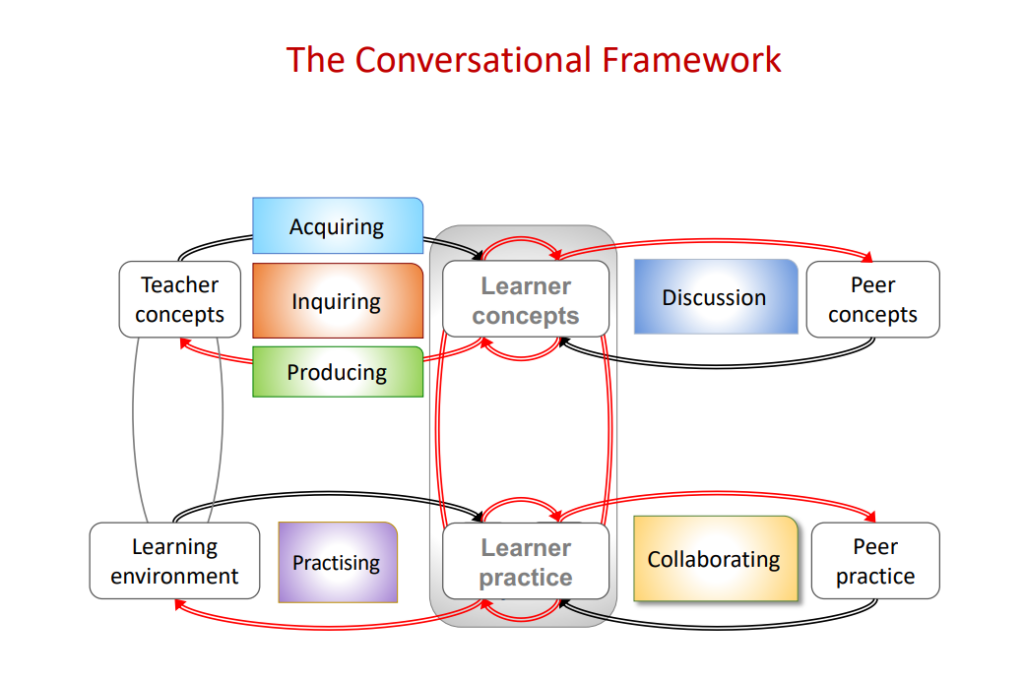
Several projects started from the ‘conversational framework’ of digital learning articulated by Diana Laurillard; her ‘Rethinking University Teaching’2 of 2002 is still required reading around the world and remains widely cited worldwide. This framework portrayed formal teaching and learning as interactions – ‘conversations’ – between the teacher’s conceptions and the learner’s conceptions and how the teacher had to devise situations or artefacts in the real world, meaning the usual formats like lectures, set books, assessments, lab experiments, field trips, seminars, group projects and online chat, that would enable the teacher’s conceptions to change the learner’s conceptions, meaning the learner would have learnt something from the teacher.
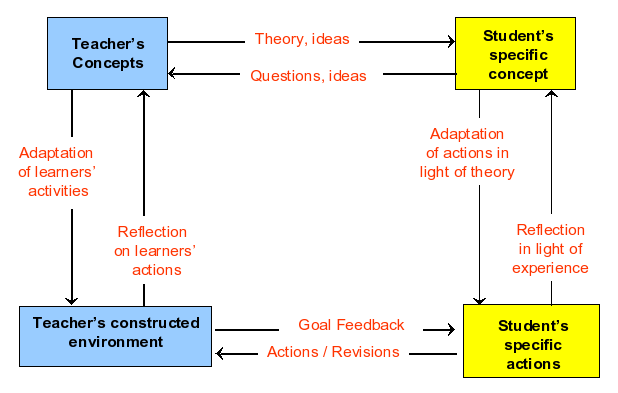
Caption: Laurillard’s Conversational Framework illustrates learning as an ongoing interaction between teacher concepts, learner concepts, real-world actions and feedback. This model became influential in the design of digital learning environments because it provided a structured way to think about how technology can support learning.
https://edutechwiki.unige.ch/en/Laurillard_conversational_framework

Each of these situations or artefacts could be classified into one of four broad categories: acquiring, inquiring, producing and practising. The framework was sometimes extended beyond individual learners to groups of learners, and these, too, had their pedagogic artefacts and situations, classified as discussion or collaboration. Of course, they could also each be analogue or digital, synchronous or asynchronous, remote or present, though some of the possibilities might be daft.
Caption: Building on the Conversational Framework, Laurillard identified six broad learning types: acquisition, inquiry, discussion, practice, production and collaboration. These categories provide a practical way to design and evaluate learning activities.
https://assets.avallain.com/wp-content/uploads/2026/06/Step_1.4_CF_screencast.pdf
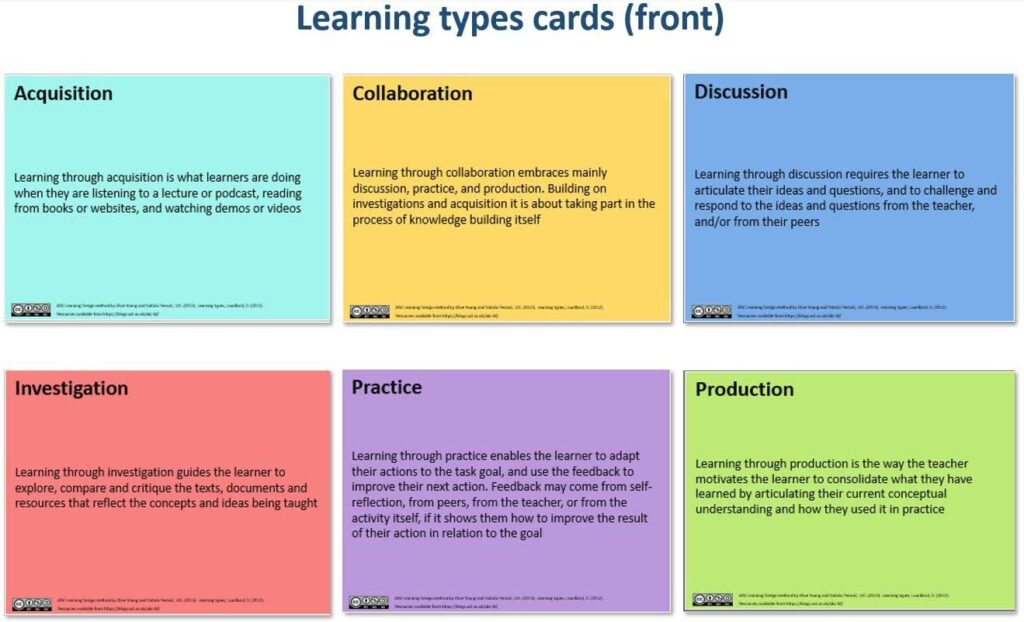
Caption: These learning types can then be mapped to specific educational activities and delivery methods, from lectures and reading to simulations and collaborative projects.
https://abc-ld.org/download-abc/part1-introduction/

These two threads, the cost of developing different functions within educational software and the ways in which these functions map onto various educational situations and artefacts, come together with research that calibrated the various educational situations and artefacts. 

Educational situations and artefacts simply refer to lectures, readings, workshops, field trips, seminars, games, coursework, examinations, practicals, role-play, tutorials, simulations, essays and projects. Then everything digital that evolved from these, web quests, webinars, lecture capture, etc., etc., etc. Researchers attempted to measure their respective educational effectiveness, perhaps in terms of something as simple as the proportion of material that was remembered, understood or applied. In short, this amounted to a form of cost-benefit analysis. For large online universities, the value of such analysis was obvious and widely exploited. The obvious examples are Laurillard’s CRAM, Course Resource Appraisal Model, now in use at London’s UCL3 and Conole’s Media Advisor4.

Summing Up

All these ideas, many rooted in the last century, remain relevant, even if the numbers and technologies have moved on; we are still trying to produce high-quality, maintainable and pedagogically effective educational digital technology with cost-effective, managed and sustainable processes. This piece starts with a fairly general critique to home in on a point at which education, technology and commerce converge in ways that remain relevant.

The lesson from software engineering and courseware engineering is not that educational technology should become more technical. Rather, it is that successful educational technology requires the same rigour, planning and discipline that other mature engineering fields developed in response to complexity.

These principles may matter more than ever as Generative and Agentic AI reshape our processes, our products, and the very nature and delivery of learning.

References

  1. Marshall, I.M., Samson, W.B., Dugard, P.I. (1994). A proposed framework for predicting the development effort of multimedia courseware. In: Herzner, W., Kappe, F. (eds) Multimedia/Hypermedia in Open Distributed Environments. Eurographics. Springer, Vienna. https://doi.org/10.1007/978-3-7091-9361-7_12 ↩︎
  2. Laurillard, D. (2002). Rethinking university teaching: a conversational framework for the effective use of learning technologies (2nd ed.). London: Routledge Falmer. ↩︎
  3. Kennedy, E., Laurillard, D., Horan, B., & Charlton, P. (2015). Making meaningful decisions about time, workload and pedagogy in the digital age: the Course Resource Appraisal Model. Distance Education, 36(2), 177–195. https://doi.org/10.1080/01587919.2015.1055920 ↩︎
  4. Conole, Grainne (2002). Systematising Learning and Research Information. Journal of Interactive Media in Education, 2002(7) ↩︎

About Avallain

For more than two decades, Avallain has enabled publishers, institutions and educators to create and deliver world-class digital education products and programmes. Our award-winning solutions include Avallain Author, an AI-powered authoring tool, Avallain Magnet, a peerless LMS with integrated AI, and TeacherMatic, a ready-to-use AI toolkit created for and refined by educators.

Our technology meets the highest standards with accessibility and human-centred design at its core. Through Avallain Intelligence, our framework for the responsible use of AI in education, we empower our clients to unlock AI’s full potential, applied ethically and safely. Avallain is ISO/IEC 27001:2022 and SOC 2 Type 2 certified and a participant in the United Nations Global Compact.

Find out more at avallain.com

_

Contact:

Daniel Seuling

VP Client Relations & Marketing
dseuling@avallain.com

From Content Creation to Learning Delivery: A Seamlessly Integrated EdTech Ecosystem for the Age of AI

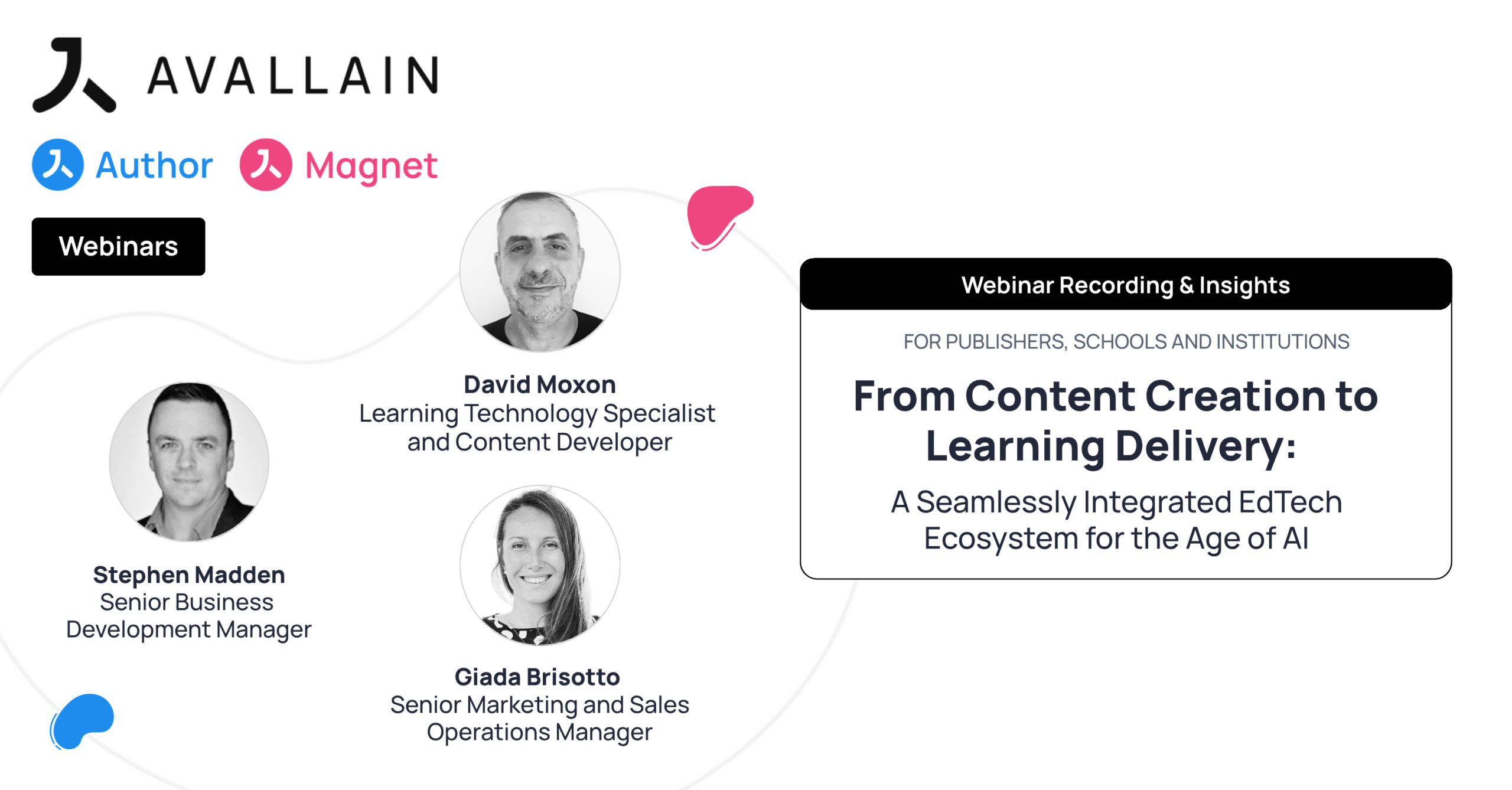
As AI introduces new opportunities for content development, publishers, schools and institutions are also looking for efficient ways to manage, deliver and maintain those learning experiences at scale. In the first session of Avallain’s new monthly product webinar series, Stephen Madden and David Moxon explored how a seamlessly integrated ecosystem can help organisations connect content creation and learning delivery, bringing together the tools needed to support the entire learning lifecycle.

From Content Creation to Learning Delivery: A Seamlessly Integrated EdTech Ecosystem for the Age of AI

St. Gallen, June 2026 – In the first session of Avallain’s new product webinar series, ‘From Content Creation to Learning Delivery: A Seamlessly Integrated EdTech Ecosystem for the Age of AI’, Stephen Madden, Senior Business Development Manager, and David Moxon, Learning Technology Specialist and Content Developer, demonstrated how Avallain Author and Avallain Magnet work as a seamlessly integrated edtech ecosystem to support the entire digital learning lifecycle.

Moderated by Giada Brisotto, Senior Marketing and Sales Operations Manager, the session explored how publishers, schools and institutions can benefit from fully connected workflows for content creation, transformation, delivery and learner management. Attendees also gained insight into Avallain Intelligence, Avallain’s framework for the responsible implementation of AI in education and saw practical demonstrations of capabilities, including the Structure Tool, MosAIc and Avallain Magnet’s learner management capabilities.

A Connected Approach to Digital Learning

Stephen opened the session by exploring how AI is reshaping educational content development and why connected workflows are becoming increasingly important across the learning lifecycle.

Central to this discussion was Avallain Intelligence. Built on principles of ethics, safety and innovation, Avallain Intelligence supports the use of AI in ways that enhance educational outcomes while maintaining transparency, quality and human oversight.

The webinar demonstrated how this approach extends across the wider Avallain ecosystem, bringing together content creation, learning delivery and learner management within a connected environment designed to support publishers, schools and institutions.

Creating Interactive Learning Content with Avallain Author

The first live demonstration focused on Avallain Author and its flexible approach to digital content creation.

Stephen showcased how authors can create, edit and preview learning activities directly within the platform, allowing content teams to move quickly from development to review while maintaining full control over structure, design and pedagogy.

The demonstration highlighted a range of interactive activity types and showed how content can be updated efficiently as requirements evolve. 

The session also introduced two approaches to AI-supported content creation. Stephen briefly highlighted GenAI, which can generate new content from prompts and will be explored in greater depth in a future webinar. He then demonstrated MosAIc, a capability designed to help organisations transform existing content into interactive digital learning experiences.

Using a sample anatomy PDF, Stephen showed how MosAIc can identify content within a document and convert it into interactive learning activities. A selected section of text was transformed into a gap-fill exercise, complete with answer options and supporting imagery drawn directly from the original source material.

The demonstration also highlighted an important consideration for publishers and institutions: the AI engine used within MosAIc does not train on customer content. Instead, content is processed solely to generate learning activities, helping organisations maintain control over proprietary and copyrighted materials.

From Content Creation to Learning Delivery

A key theme throughout the webinar was the seamless transition between content creation and learner delivery.

After creating content in Avallain Author, Stephen demonstrated how learning materials can move directly into Avallain Magnet, providing a connected workflow that links authoring and delivery within the same ecosystem.

This integration helps organisations maintain consistency across learning experiences while simplifying the process of publishing and managing content. Rather than treating authoring and delivery as separate stages, the webinar demonstrated how they can work together within a single workflow that supports the entire learning lifecycle.

Managing Learning with Avallain Magnet

David Moxon then introduced Avallain Magnet, demonstrating how learning programmes, users and institutions can be managed within a single platform.

The session explored a range of capabilities, including course administration, assignments, communication tools, learner feedback, progress tracking and reporting. Attendees saw how educators can support learners throughout their journey while maintaining visibility into participation, performance and outcomes.

David also demonstrated Magnet’s ability to support multiple independent institutions within a single environment. This enables educational providers to manage different organisational structures, audiences and commercial models from one platform while maintaining separation where required.

By combining learning delivery, communication and reporting within the same ecosystem, Magnet helps organisations create more connected and scalable digital learning experiences.

Supporting Responsible AI Adoption in Education

Throughout the webinar, Stephen emphasised that AI should enhance, rather than replace, educational expertise. Through Avallain Intelligence, Avallain takes a human-centred approach to AI implementation, combining innovation with ethical principles, transparency and safety.

As demonstrated through capabilities such as GenAI and MosAIc, AI can help accelerate content development and transformation workflows while ensuring educators, instructional designers and subject matter experts remain firmly in control of learning outcomes.

Watch the Recording

Missed the live session or would like to revisit the discussion?

Watch the full webinar recording to discover how Avallain Author and Avallain Magnet work together to support the entire digital learning lifecycle, from content creation and transformation to learner delivery, engagement and management.

Continue the Conversation in Our Next Webinar

This session marked the first webinar in Avallain’s new product webinar series, which explores how educational organisations can create, deliver and manage meaningful digital learning experiences through a seamlessly integrated edtech ecosystem.

The next webinar, ‘Learning Outcomes That Matter: Delivering Impactful Teaching and Learning with Avallain Magnet’, will take a deeper look at Avallain Magnet, our peerless, AI-integrated LMS and how it supports the creation and delivery of interactive, impactful and highly personalised teaching and learning experiences.

This session will be hosted by Alina Sitnik, Customer Success Manager, and Stephen Madden, Senior Business Development Manager, and moderated by Giada Brisotto, Senior Marketing and Sales Operations Manager. We will explore how organisations can use Avallain Magnet to manage multiple institutional structures and commercial models from a single platform while delivering engaging learning experiences that adapt to evolving educational needs.

When? 

Wednesday, 15th July 

14:00 – 14:30 BST / 15:00 – 15:30 CEST 

Discover how a flexible, scalable and fully integrated LMS can streamline your edtech ecosystem and support better learning outcomes.


About Avallain

For more than two decades, Avallain has enabled publishers, institutions and educators to create and deliver world-class digital education products and programmes. Our award-winning solutions include Avallain Author, an AI-powered authoring tool, Avallain Magnet, a peerless LMS with integrated AI, and TeacherMatic, a ready-to-use AI toolkit created for and refined by educators.

Our technology meets the highest standards with accessibility and human-centred design at its core. Through Avallain Intelligence, our framework for the responsible use of AI in education, we empower our clients to unlock AI’s full potential, applied ethically and safely. Avallain is ISO/IEC 27001:2022 and SOC 2 Type 2 certified and a participant in the United Nations Global Compact.

Contact:

Daniel Seuling

VP Client Relations & Marketing
dseuling@avallain.com

Avallain Earns EcoVadis Bronze Rating, Reinforcing Its Commitment to Responsible Innovation and Sustainability

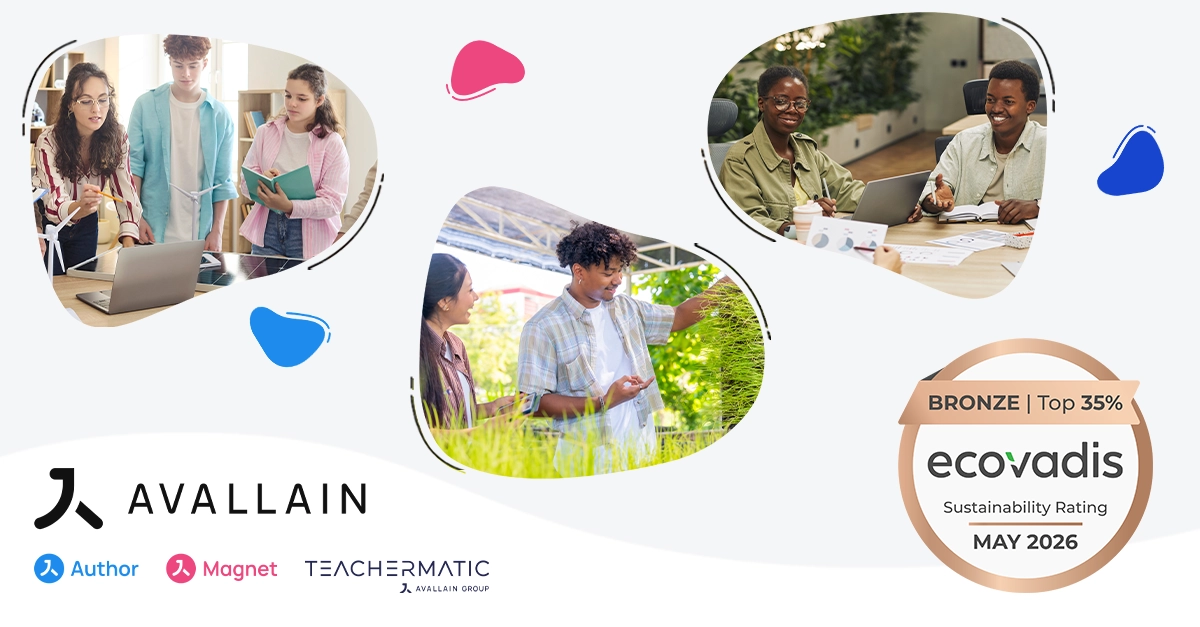
Earlier this year, Avallain published its Environmental Impact Statement, outlining the principles that guide its approach to responsible AI, renewable energy and sustainable operations. In May 2026, these efforts were independently assessed by EcoVadis, resulting in a Bronze Medal rating, placing Avallain among the top 35% of organisations evaluated globally.

Avallain Earns EcoVadis Bronze Rating, Reinforcing Its Commitment to Responsible Innovation and Sustainability

St. Gallen, June 2026 – Sustainability is often discussed in terms of targets, frameworks and reporting requirements. While these are important, they should not be the reason organisations invest time and resources in this work.

The environmental and social challenges facing the world require action from governments, communities and businesses alike. For technology companies and increasingly for organisations developing and deploying AI, there is a responsibility to understand the impact of business decisions, use resources thoughtfully and contribute positively wherever possible.

Against this backdrop, Avallain has been awarded a Bronze Medal by EcoVadis, one of the world’s leading providers of business sustainability ratings. The assessment places the company among the top 35% of organisations evaluated globally and provides independent recognition of its approach to environmental responsibility, ethical governance, workplace practices and sustainable procurement.

From Commitment to Independent Assessment

Earlier this year, Avallain published its Environmental Impact Statement, setting out its approach to responsible AI, renewable energy, emissions reporting and sustainable operations.

The EcoVadis assessment provides an external evaluation of how those commitments are reflected across the organisation. The review covers four key areas:

  • Environment
  • Labour & Human Rights
  • Ethics
  • Sustainable Procurement.

While the Bronze Medal rating achieved provides an important benchmark, it is not the destination. Sustainability is an ongoing process of learning, measuring, improving and taking responsibility for the impact organisations have on the world around them.

Why Sustainability Matters for Education Organisations

Educational institutions, publishers and learning providers are increasingly expected to demonstrate responsible business practices throughout their supply chains. Sustainability, governance and ethical standards have become important considerations alongside product quality, innovation and security.

For organisations working with Avallain, the EcoVadis assessment provides an independent evaluation of the policies, practices and reporting that support the company’s operations.

Rather than relying solely on internal commitments, clients and partners can reference a recognised third-party assessment that measures performance across the four key areas mentioned above.

The value of this approach is increasingly recognised across the education sector. Partners such as Cambridge University Press & Assessment have acknowledged Avallain’s efforts to achieve the EcoVadis Bronze Medal and to continue strengthening its sustainability practices. As sustainability becomes a more important consideration in supplier relationships, independent assessments help create greater transparency and support ongoing collaboration around shared environmental and social goals.

Responsibility Beyond Compliance

Sustainability is not simply about meeting requirements or responding to industry expectations.

For Avallain, it means making deliberate choices about how technology is developed, how AI is applied, how energy is consumed and how business relationships are managed. It means recognising that every organisation has a role to play in reducing negative impacts and contributing to a more sustainable future.

The EcoVadis assessment highlighted a range of initiatives already embedded across the business, including investments in renewable energy, employee wellbeing programmes, information security governance and supplier sustainability processes.

Together, these efforts help create a more resilient organisation and support the long-term relationships that Avallain builds with educational institutions, publishers and learning providers worldwide. More importantly, they reflect a commitment to ensuring that innovation and growth are pursued responsibly, with consideration for their wider environmental and social impact.

Responsible Innovation in the Age of AI

As digital technologies continue to evolve, organisations are increasingly looking beyond product functionality and considering the broader impact of the companies they choose to work with.

Avallain’s approach combines technological innovation with responsible business practices, including accessibility, information security, environmental stewardship and Avallain Intelligence, the company’s framework for the responsible use of AI in education. Through Avallain Intelligence, AI is applied where it delivers meaningful value for educators and learners while maintaining transparency, human oversight, pedagogical integrity and responsible governance.

This approach reflects a belief that educational technology should not only improve learning experiences but also be developed in ways that support trust, accountability and long-term sustainability.

Continuing the Journey

The EcoVadis assessment also identified opportunities for further development, including additional reporting, target setting and process improvements.

Avallain welcomes these findings as part of the continuous improvement process. Sustainability is not a one-time achievement but an ongoing commitment to transparency, accountability and meaningful action.

The insights provided through EcoVadis will help shape future priorities as the company continues to strengthen its environmental, social and governance practices.


About Avallain

For more than two decades, Avallain has enabled publishers, institutions and educators to create and deliver world-class digital education products and programmes. Our award-winning solutions include Avallain Author, an AI-powered authoring tool, Avallain Magnet, a peerless LMS with integrated AI, and TeacherMatic, a ready-to-use AI toolkit created for and refined by educators.

Our technology meets the highest standards with accessibility and human-centred design at its core. Through Avallain Intelligence, our framework for the responsible use of AI in education, we empower our clients to unlock AI’s full potential, applied ethically and safely. Avallain is ISO/IEC 27001:2022 and SOC 2 Type 2 certified and a participant in the United Nations Global Compact.

Contact:

Daniel Seuling

VP Client Relations & Marketing
dseuling@avallain.com

How to Make IELTS Preparation More Targeted and Engaging with a Purpose-Built AI Tool

The latest Language Teaching Takeoff Webinar welcomed back Joanna Szoke, freelance teacher trainer and AI in education specialist. During the session, she demonstrated how teachers can use the TeacherMatic ‘IELTS Style Test Prep Generator’ to create personalised IELTS-style practice materials and support more effective exam preparation.

How to Make IELTS Preparation More Targeted and Engaging with a Purpose-Built AI Tool

London, June 2026 – In ‘Boost Learner Confidence with Engaging, Targeted IELTS-Style Practice Materials’, Joanna Szoke explored one of the biggest challenges in exam preparation: to move beyond repetitive practice papers and create learning experiences that genuinely help students improve. She demonstrated how the TeacherMatic ‘IELTS Style Test Prep Generator’ can be used to create IELTS-style reading practice tailored to different learner needs, with customisable task types, difficulty levels and strategy guidance.

Moderated by Alba Melián, Marketing and Sales Operations Consultant at Avallain, the session focused on making exam preparation more engaging, targeted and effective. Joanna shared practical approaches to extending exam activities, developing subskills and helping learners understand not just what the correct answer is, but how to approach tasks more successfully.

Making Exam Preparation More Meaningful

To start the session, Joanna invited attendees to reflect on their own experiences when teaching for exam preparation. She highlighted three common challenges: keeping learners engaged, avoiding overreliance on practice papers and supporting students with exam techniques when teachers may not have taken the exam themselves.

Drawing on her own teaching experience, she finds that learner engagement is often the biggest concern. When teachers are unsure how to make these lessons more interesting, it can be tempting to rely heavily on practice papers. While these have an important role to play, using them in isolation can lead to repetitive lessons that do little to sustain learner motivation.

Instead, Joanna encouraged teachers to personalise and extend exam activities. This could involve incorporating learner interests, hobbies or familiar topics into practice materials. 

Meaningful progress depends on helping learners understand how to approach different question types, develop relevant subskills and reflect on their performance. As one attendee observed, without feedback, nothing can change.

For those who have never taken the exams themselves and feel they lack credibility, Joanna recommended trusted resources and expert guidance. Whether using established exam preparation materials or purpose-built AI tools such as the TeacherMatic ‘IELTS Style Test Prep Generator’, teachers should ensure that the support they provide is grounded in credible, reliable sources.

A Purpose-Built Approach to IELTS Preparation

To address these challenges, Joanna introduced the TeacherMatic ‘IELTS Style Test Prep Generator’, a purpose-built AI tool designed specifically for IELTS preparation. Rather than simply generating practice materials, it enables teachers to create IELTS-style reading activities that can be adapted to different learner needs while supporting more meaningful exam preparation.

Teachers can select from a range of task types, adjust the difficulty level and choose to include additional support materials. These features make it easier to personalise activities and extend learning beyond a single task, helping learners understand not only the correct answer, but how to approach exam questions more effectively.

The generator currently supports IELTS Reading preparation and allows teachers to export materials as Word documents or PDFs for further adaptation and classroom use. As with all AI-generated content, Joanna emphasised the importance of reviewing outputs and applying professional judgement before sharing them with learners.

Putting It into Practice

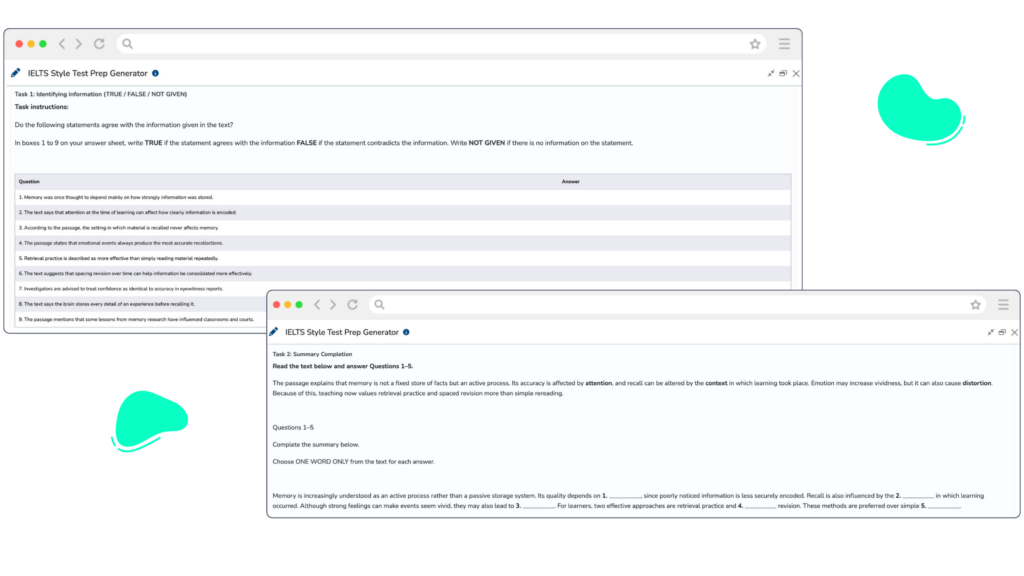
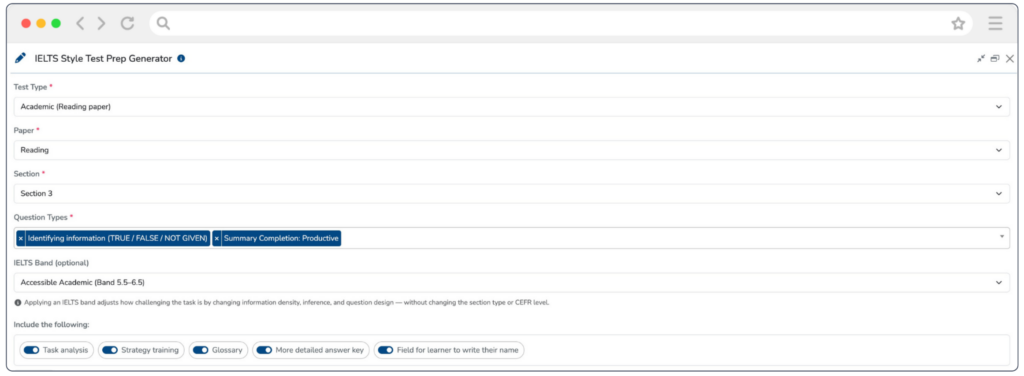
To demonstrate the generator, Joanna created an IELTS Academic Reading activity. After selecting the Reading paper and Section 3, she chose two question types: Summary Completion and True/False/Not Given.

She then selected the Accessible Academic band (5.5–6.5), demonstrating how teachers can tailor activities to different learner levels while remaining aligned with IELTS requirements and level descriptors. Teachers can also instruct the generator to include additional support materials in the output, such as detailed answer explanations, task analysis, strategy guidance and glossaries.

AI Outputs That Support Real Teaching and Learning

Joanna then showcased the generated resource, which combined IELTS-style reading tasks with a range of additional materials designed to support both teaching and learning.

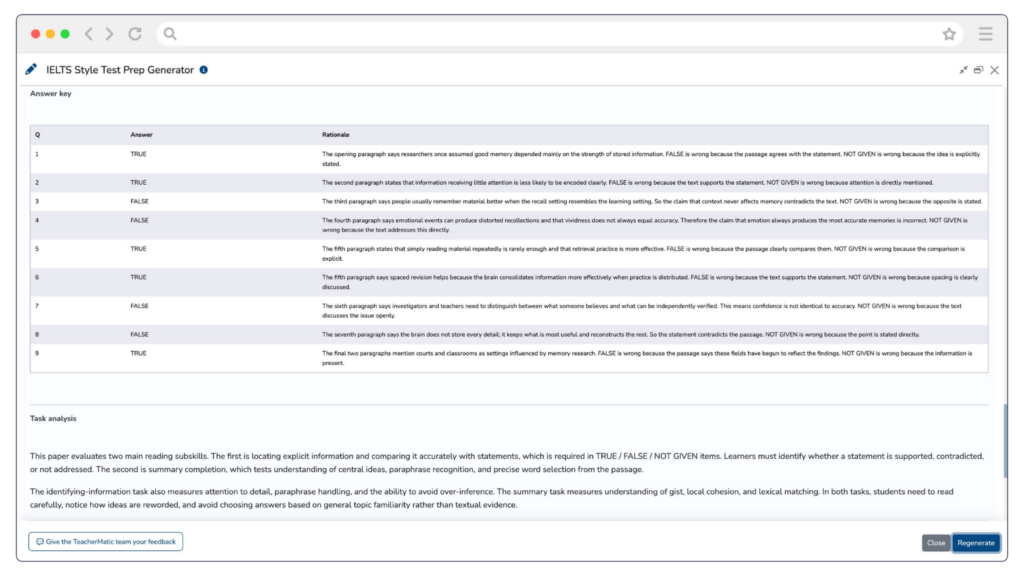
Alongside the activity itself, the generator produced a glossary, detailed answer explanations, task analysis and strategy guidance. Joanna explained how these additional elements can help teachers provide greater context for exam tasks, support learners’ understanding and create opportunities for further learning beyond the activity itself.

Beyond the Generated Activity

For Joanna, the real value lies not only in the generated activity itself, but in how teachers choose to use it.

She demonstrated how the glossary could be repurposed as a matching activity before learners begin the reading task, creating opportunities for vocabulary development and activating prior knowledge. Alternatively, it could be used after the activity as a revision exercise to reinforce new language.

Joanna also highlighted the value of task analysis and strategy guidance, particularly for teachers new to exam preparation. These additions explain what each task is assessing and provide practical techniques that teachers can share with learners. 

Finally, Joanna encouraged teachers to personalise activities whenever possible. By refining the generated text to include learner names, interests or hobbies, teachers can create more engaging experiences. She suggested turning these references into a treasure-hunt activity, encouraging learners to scan the text for familiar details before completing the exam task.

Supporting Every Stage of IELTS Preparation

Generated activities can also be incorporated into a broader teaching workflow. Once created, IELTS-style reading activities can be saved and reused with other TeacherMatic generators, including the ‘Lesson Plan’ generator. This enables the creation of complete IELTS preparation lessons tailored to specific learners’ needs.

Throughout the session, Joanna emphasised that effective exam preparation requires more than exposure to exam tasks alone. Learners need opportunities to develop subskills, practise exam techniques and understand how classroom activities connect to real-world language use.

As she explained:

‘Don’t just do practice papers one after the other, because that’s not going to really help students learn, but focus on the connection between the exam task and real life. Students, in this generation, appreciate this kind of connection a lot.’

Joanna also highlighted the importance of gathering and providing feedback throughout the learning journey. This helps educators identify where learners need additional support, understand learner progress and refine future activities accordingly.

An AI Toolkit Designed for Language Teachers

The ‘IELTS Style Test Prep Generator’ is just one of more than 50 generators available within the TeacherMatic Language Teaching Edition, an AI toolkit designed specifically for language educators. In addition to creating IELTS-style activities, teachers can generate lesson plans and supporting resources to streamline feedback processes.

Built around language teaching methodologies and responsible approaches to AI adoption, the toolkit helps educators integrate AI into their practice while maintaining professional judgement and control over teaching and learning decisions.

Next in the Webinar Series

Join special guest host Pilar Capaul, language teacher and ELT content creator, for the next Language Teaching Takeoff Webinar.

Reading, Vocabulary and Grammar: Practical AI Tools for Everyday Language Teaching

🗓 Thursday, 9th July
🕛 12:00 – 12:30 BST (13:00 – 13:30 CEST)

Discover three new TeacherMatic AI generators designed to support reading, vocabulary and grammar development. You’ll learn how to use purpose-built AI tools to create engaging, CEFR-aligned teaching materials.  


About Avallain

For more than two decades, Avallain has enabled publishers, institutions and educators to create and deliver world-class digital education products and programmes. Our award-winning solutions include Avallain Author, an AI-powered authoring tool, Avallain Magnet, a peerless LMS with integrated AI, and TeacherMatic, a ready-to-use AI toolkit created for and refined by educators.

Our technology meets the highest standards with accessibility and human-centred design at its core. Through Avallain Intelligence, our framework for the responsible use of AI in education, we empower our clients to unlock AI’s full potential, applied ethically and safely. Avallain is ISO/IEC 27001:2022 and SOC 2 Type 2 certified and a participant in the United Nations Global Compact.

Contact:

Daniel Seuling

VP Client Relations & Marketing
dseuling@avallain.com