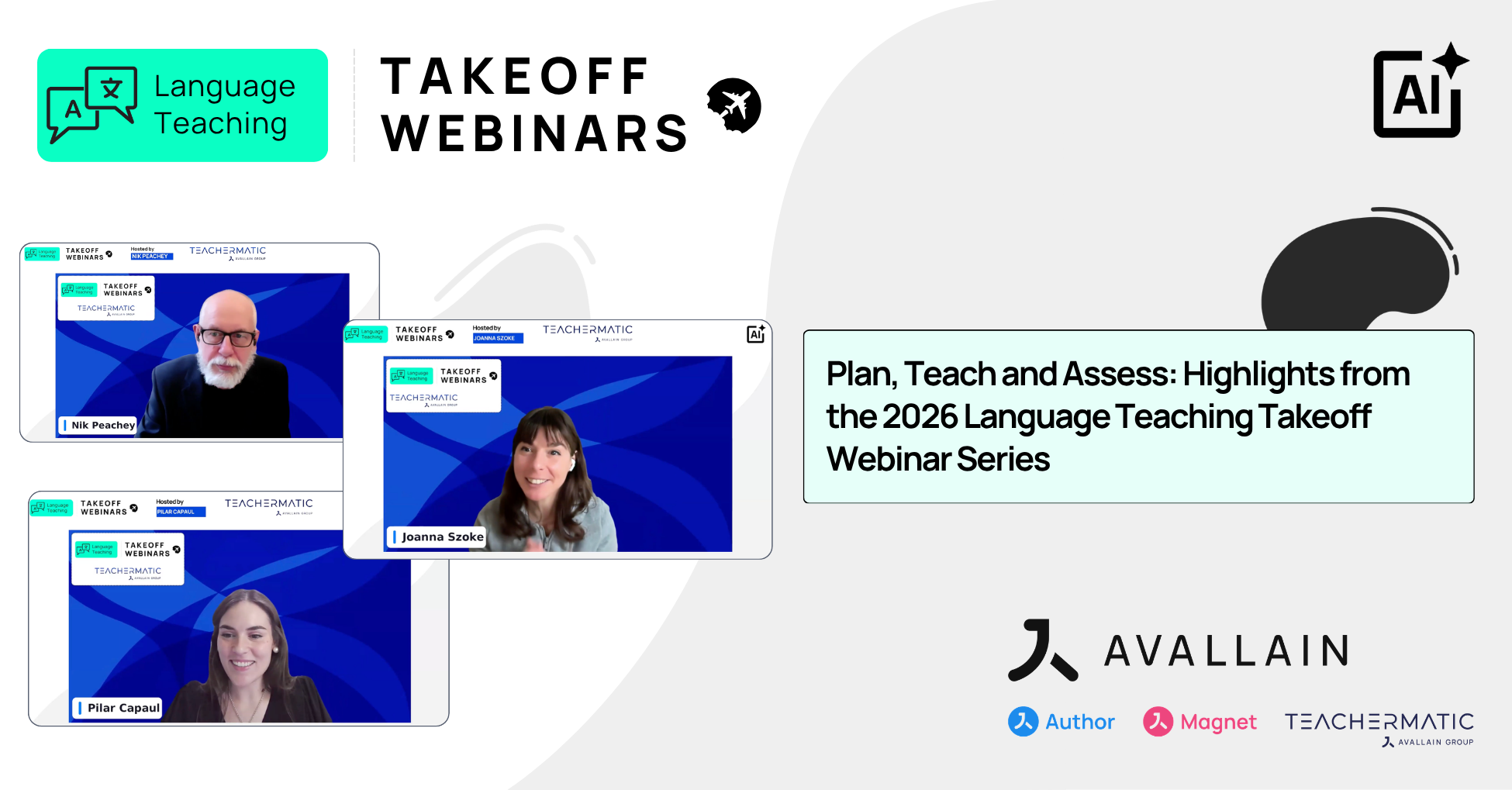
Throughout the first half of 2026, the Language Teaching Takeoff Webinar Series has brought together three language teaching experts to explore how TeacherMatic can support every stage of language teaching, from planning and lesson preparation to classroom engagement, assessment and feedback. This blog revisits the highlights from the series so far, exploring the key ideas, teaching strategies and webinar recordings.
Plan, Teach and Assess: Highlights from the 2026 Language Teaching Takeoff Webinar Series
London, August 2026 – Across the series, each host draws on their own area of expertise to demonstrate how TeacherMatic can be applied in different contexts. Attendees discover practical strategies, explore purpose-built AI generators and learn how to integrate AI meaningfully and responsibly into planning, teaching and assessment while maintaining full pedagogical control.
Designed specifically for language teaching, the TeacherMatic Language Teaching Edition enables language educators to generate comprehensive schemes of work, adapt content for different CEFR levels, provide meaningful feedback, create engaging exam practice, inspire students and much more.
Since the series began, more than 900 educators have joined the webinar series to explore responsible AI in language education and discover practical ways to support confident language learners with TeacherMatic.
Meet the Hosts
The expertise behind the Language Teaching Takeoff Webinar Series is what makes each session valuable. Combining experience across language teaching, educational technology, teacher training and content creation, our hosts share their knowledge, practical insights and passion for improving language teaching through thoughtful use of technology.
Nik Peachey is an award-winning educator, author and edtech specialist with extensive experience in digital learning, teacher development and pedagogical innovation. He offers strategic perspectives on course development, lesson planning, CEFR alignment and the effective use of technology in education.
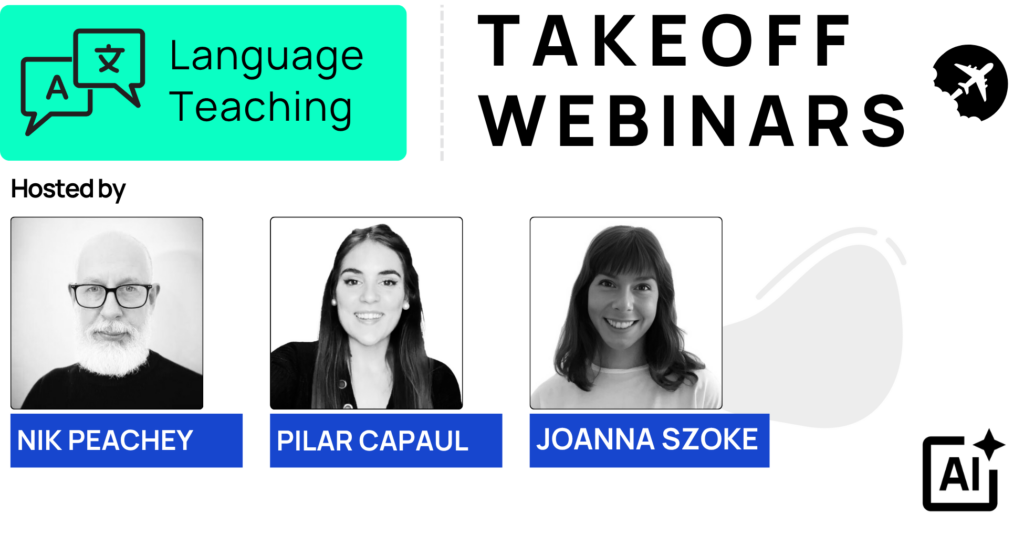
Everyday classroom experience is brought to the series by Pilar Capaul. As a language teacher and ELT content creator, she shares practical strategies drawn from her own teaching practice and experience creating engaging resources for language learners.
Joanna Szoke is a freelance teacher trainer and AI in education specialist with a particular focus on assessment, feedback, exam preparation and responsible AI adoption. Her work centres on creating meaningful assessment experiences and exploring how emerging technologies can genuinely support educators in the classroom.
The sessions are moderated by Giada Brisotto, Senior Marketing and Sales Operations Manager, and Alba Melián, Marketing and Sales Operations Consultant, who use their own language teaching experience to guide thoughtful discussions and connect ideas across each session.
Plan, Prepare and Make Informed CEFR Decisions
Nik Peachey has focused his sessions this year on effective planning and informed CEFR alignment, demonstrating how educators can combine their professional knowledge with purpose-built AI tools.
Plan Smarter and Teach with Confidence
In ‘Plan Smarter and Teach with Confidence’, Nik demonstrated how teachers, academic managers and directors of studies can use TeacherMatic’s AI generators, including ‘Scheme of Work / Curriculum’, to support different stages of course and lesson planning.
Highlights included how to:
- Create structured schemes of work around learner needs, course aims and pedagogical approaches.
- Develop CEFR-aligned lesson plans from individual sessions.
- Create purposeful lesson wrap-ups to reinforce learning and reflection.
Make Informed CEFR Alignment Decisions in the Age of AI
CEFR alignment has been a key focus for Nik this year. In ‘Make Informed CEFR Alignment Decisions in the Age of AI’, he explored how a deeper understanding of the framework can empower educators to make more informed decisions when creating and adapting materials with AI.
Nik introduced the free ‘CEFR Alignment for Teachers: In the Age of AI’ course, developed in collaboration with the Norwich Institute for Language Education (NILE). He further demonstrated how educators can put these principles into practice with TeacherMatic.
Key takeaways included:
- Understanding what meaningful CEFR alignment involves, beyond simply assigning content an A1 to C2 level.
- Applying professional judgement when creating and evaluating AI-generated materials.
- Creating and adapting content for different CEFR levels and learner needs using the ‘Create a Text’ and ‘Adapt your Content’ generators.
- Using the ‘CEFR Level Checker’ to review materials and inform further adaptation.
Teach, Inspire and Create Engaging Learning Experiences
Pilar Capaul has brought an everyday classroom perspective to the series, sharing practical ways to create engaging activities, monitor understanding and adapt materials around the needs and interests of learners.
Inspire, Monitor, Motivate: Practical AI Tools for Everyday Teaching
In ‘Inspire, Monitor, Motivate: Practical AI Tools for Everyday Teaching’, Pilar drew on examples from her own lessons to demonstrate how TeacherMatic can empower educators to respond to everyday classroom challenges.
Highlights included how to:
- Turn homework checks into engaging warm-up activities with the ‘Did you do your homework?’ generator, helping educators check comprehension and identify areas to revisit.
- Generate fresh ideas with the ‘Inspiration!’ generator to make familiar or less engaging topics more motivating.
- Adapt activities around different learner profiles, levels and teaching approaches.
Reading, Vocabulary and Grammar: Practical AI Tools for Everyday Language Teaching
In July, Pilar continued this practical classroom focus in ‘Reading, Vocabulary and Grammar: Practical AI Tools for Everyday Language Teaching’. Using the ‘Reading Comprehension’, ‘Open Cloze’ and ‘Word Formation’ generators, she demonstrated how educators can create connected, CEFR-aligned activities around authentic content, tailoring each resource to their learners and lesson objectives.
Key takeaways included:
- Bringing authentic content into lessons by turning sources such as online videos into relevant, CEFR-aligned reading activities.
- Building grammar and vocabulary practice around the same source material to create a more cohesive learning experience.
- Refining materials around specific CEFR levels, learner needs, language points, lesson objectives and teaching contexts.
- Creating a reusable library of resources. Save, organise, adapt and share generated materials for future lessons.
Prepare, Assess and Provide Meaningful Feedback
Joanna Szoke has focused on assessment, feedback and exam preparation throughout the series, exploring how educators can support learner progress and confidence with AI.
Create Dynamic and Engaging Exam Practice for Your Students
In ‘Create Dynamic and Engaging Exam Practice for Your Students’, Joanna explored how assessment and exam preparation can become opportunities for learning, rather than simply measuring performance.
Highlights included how to:
- Create targeted Cambridge-style exam practice for different levels with the ‘Cambridge Style Exam Prep Generator’.
- Connect exam activities with real-life language use and learner interests.
- Develop adaptable worksheets and practice materials with the ‘Worksheet’ generator to address specific learner needs.
Provide Meaningful, Timely Feedback at Scale with the Power of AI
Providing meaningful feedback is a particular passion for Joanna. In ‘Provide Meaningful, Timely Feedback at Scale with the Power of AI’, she explored what makes feedback genuinely useful and how AI can enable educators to deliver it more efficiently without losing the human judgement that gives it value.
Joanna demonstrated the TeacherMatic ‘Advanced Feedback’ generator, showing how educators can streamline feedback workflows while remaining actively involved in reviewing, refining and deciding what is ultimately shared with learners.
Key takeaways included:
- Making feedback actionable by giving learners timely, specific guidance that helps them understand how to improve.
- Turning feedback into continued learning with clear next steps and targeted follow-up activities.
- Managing feedback more efficiently with individual or multiple submissions while maintaining oversight of the feedback provided.
- Reviewing and refining AI-generated feedback before sharing it with learners.
Boost Learner Confidence with Engaging, Targeted IELTS-Style Practice Materials
In ‘Boost Learner Confidence with Engaging, Targeted IELTS-Style Practice Materials’, Joanna returned to exam preparation, this time focusing specifically on IELTS-style reading practice and how educators can move beyond repetitive practice papers.
Highlights included how to:
- Tailor IELTS-style reading practice to different learner needs with the ‘IELTS Style Test Prep Generator’, including task types and difficulty levels.
- Build exam strategies and subskills alongside task practice.
- Use glossaries, answer explanations and strategy guidance to extend learning beyond the activity itself.
Joanna also emphasised the importance of making exam preparation meaningful for learners:
‘Don’t just do practice papers one after the other, because that’s not going to really help students learn, but focus on the connection between the exam task and real life. Students, in this generation, appreciate this kind of connection a lot.’
Supporting Every Step of the Language Teaching Journey
Across planning, teaching and assessment, the Language Teaching Takeoff Webinar Series reflects a genuine and shared passion for language education and a determination to empower educators as they create meaningful, effective learning experiences.
Nik, Joanna and Pilar each bring their own expertise and perspective, but share the same commitment to pedagogical quality and thoughtful use of technology. Throughout the series, they have shown how AI can be embraced responsibly, with professional judgement, teacher integrity and the needs of learners remaining central.
The TeacherMatic Language Teaching Edition makes this possible with responsible, purpose-built AI generators designed specifically for language education. Educators can use these tools to plan and prepare resources, create engaging learning activities, assess progress and provide meaningful feedback. By making these tasks more efficient, educators can focus more of their time and expertise on building confident language learners.
Next in the Webinar Series
In our next webinar, discover the new ‘Grammar analysis’ generator and learn how AI can support more informed decisions when selecting and teaching authentic texts.
AI Grammar Analysis for Better Teaching Decisions
🗓 Thursday, 17th September
🕛 12:00 – 12:30 BST (13:00 – 13:30 CEST)
About Avallain
For more than two decades, Avallain has enabled publishers, institutions and educators to create and deliver world-class digital education products and programmes. Our award-winning solutions include Avallain Author, an AI-powered authoring tool, Avallain Magnet, a peerless LMS with integrated AI, and TeacherMatic, a ready-to-use AI toolkit created for and refined by educators.
Our technology meets the highest standards with accessibility and human-centred design at its core. Through Avallain Intelligence, our framework for the responsible use of AI in education, we empower our clients to unlock AI’s full potential, applied ethically and safely. Avallain is ISO/IEC 27001:2022 and SOC 2 Type 2 certified and a participant in the United Nations Global Compact.
_
Contact:
Daniel Seuling
VP Client Relations & Marketing
