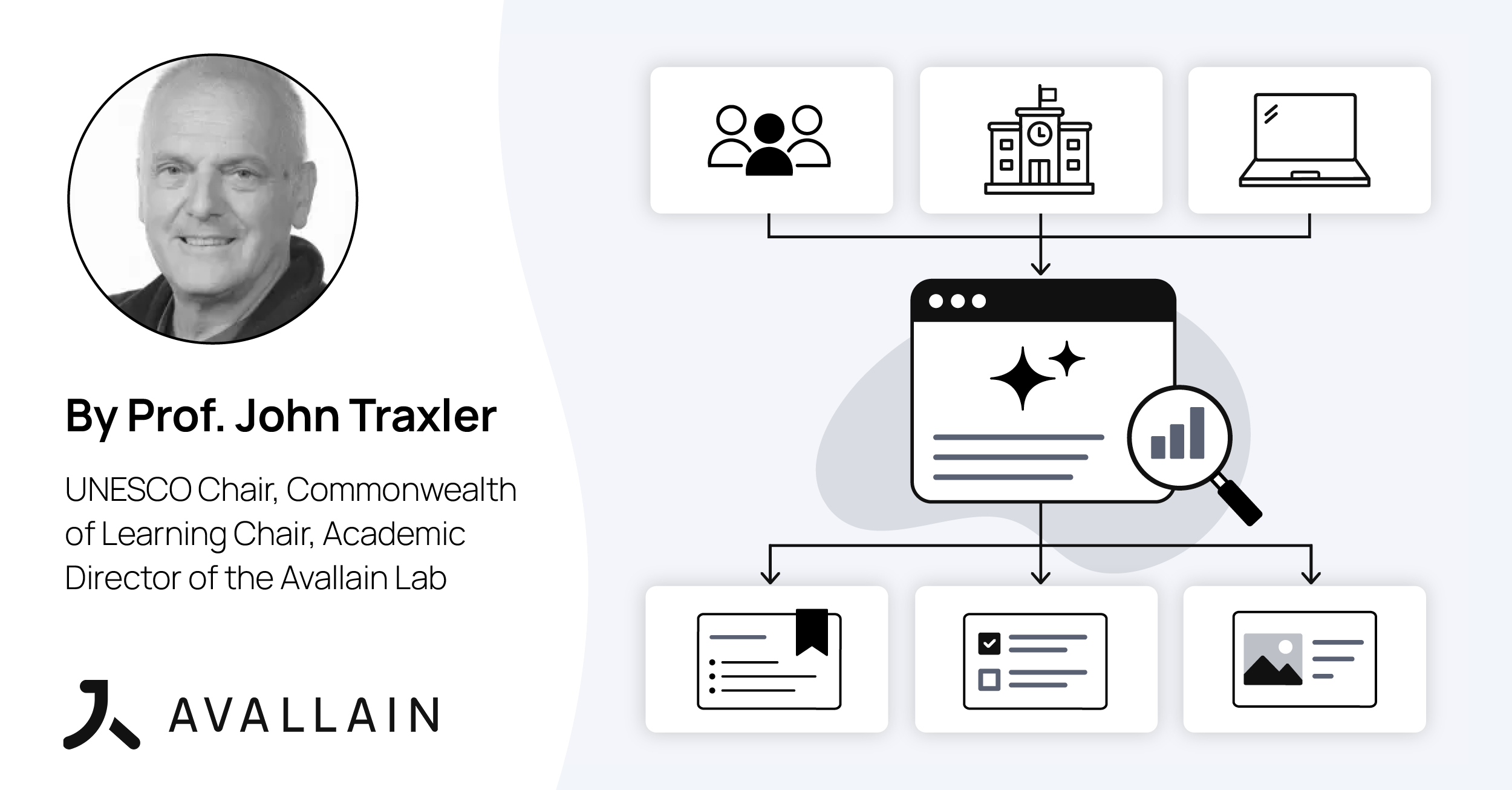
Can GenAI provide better educational support when given more information about the specific context of teaching and learning? In this article, Prof. John Traxler explores this question through a series of informal experiments, testing how small changes in classroom circumstances, teaching approaches and learner characteristics influence AI-generated educational resources. He examines whether GenAI can produce context-sensitive responses, support different pedagogical approaches and accommodate diverse learner needs, while reflecting critically on the findings and their implications for teachers and education.
Can GenAI Be Better at Supporting Teaching?
Author: Prof. John Traxler, UNESCO Chair, Commonwealth of Learning Chair and Academic Director of the Avallain Lab
St. Gallen, November 23, 2026 – Currently, some applications of AI in education could be perceived by some as a fairly blunt instrument that teachers use to assist their learners. They do not necessarily respond to any individual situation defined by individual learners, the group these learners constitute or the teachers who teach them.
Much of the current use of AI in education focuses on generalised workload reductions for teachers by providing resources intended to work across a range of settings in a fairly didactic pedagogy, one that is scalable and teacher-centred. This is perhaps understandable because it exploits generative AI’s powerful ability to retrieve and manipulate content, variously textual, pictorial, diagrammatic, audio or video, and addresses the pressures on teachers to produce vast amounts of content.
Our general question here is, if we were able to supply an educational AI application, or rather the generative AI system which powers it, with the specifics of an educational situation, would it make any difference? A subsidiary question might be, are some generative AI systems better at this than others?
This blog unpacks these general questions into more concrete specifics and reports on some informal experiments.
Experimental Premise
These experiments have consisted of devising two prompts asking for a range of resources, perhaps a lesson plan, an assessment or a slide deck, specifying as much of the context as possible but making a slight difference in one characteristic or dimension in order to see whether that characteristic or dimension made any difference and whether any such differences were significant and appropriate.
Broadly speaking, we might be asking: can generative AI, firstly, with its resources, replicate the common-sense responses that one would expect from an experienced and responsive – or savvy – teacher; secondly, with its resources, provide more pedagogic diversity; and thirdly, can its resources respond to the diversity of learners.
Can AI Replicate Common-Sense Responses?
The kind of issues and questions that might differentiate different common-sense responses from a teacher might be: is it a big class or a small one, is it a short class or a long one, is it just before Monday lunchtime or just before going home on a Friday afternoon, was the class in a lecture theatre, computer lab or workshop? These are just examples, but the point is that an experienced teacher would be approaching a small group of senior citizens on a Wednesday morning very differently from a large group of adolescents on a Friday afternoon, all things being equal, meaning, same topic, same level, same assessment, etc.
The answer seems to be that generative AI systems can distinguish between these different contexts and produce responses that appear appropriate, and perhaps the next stage of this process is to make the differences smaller and smaller, less obvious and less glaring, perhaps two identical groups but before and after Wednesday lunchtime. Though, of course, an experienced teacher might see no reason to teach those two classes, before and after lunch, any differently. In that case, perhaps we should not expect AI systems to do so either.
This approach is experimental, trying to isolate three different aspects of teaching, but in reality prompts would embrace all three and recognise their interconnectedness.
Can AI Devise Resources for Pedagogical Diversity?
Another aspect is pedagogical diversity. Can we ask, for example, for a slide deck or lesson plan that is constructivist or social constructivist rather than defaulting to didactic or transmissive? Can generative AI devise resources that recognise and exploit the backgrounds, culture, experiences and understandings of individual learners in the case of constructivism, or can it devise resources that get learners working together, contributing and collaborating, for social constructivism?
Again, the initial results suggest a ‘yes’; even in the case of slide decks, where these can provide the necessary cues and stimuli for individual contributions and group collaborations, suggesting that slide decks are not just a transmissive medium to be silently read by learners or recited by teachers and thus merely passively consumed, and might in fact be a ‘Trojan mouse’ for pedagogic change rather than merely entrenching the status quo by making it more efficient.
Can AI Respond to the Diversity of Learners?
There is not only a pedagogic justification for these experiments but also an ethical one, pushing our AI tools to help us recognise the individuality of our learners rather than treating them as resources that assume ‘one-size-fits-all’. We could extend this approach by specifying more about the teacher, noting whether they are young, old, experienced, novice, subject specialist, generalist or a supply teacher. This also works, providing resources that better match the teacher profile.
Likewise, we have been exploring the capacity of AI to respond to the diversity of learners. Specifically, as before, we have to ask: do we get targeted and appropriate responses and resources if we specify different age, gender, ethnicity, demographics, prior achievements or any other variable or mixture of variables that teachers might spot and respond to in their classes?
Again, the initial results suggest a ‘yes’. AI systems can produce responses that appear appropriate and, in every case, should, if asked, provide well-argued explanations, though, as ever, humans should always check that these responses are educationally justified and not based on assumptions or stereotypes.
A further refinement to these experiments would be to compare the responses of different AI systems, say Gemini vs Copilot vs ChatGPT.
What Does This Mean for Teaching and Learning?
The results suggest that GenAI can move beyond generic educational resources and respond to the complexities of different teaching and learning contexts. However, generating context-sensitive responses is not the same as understanding the pedagogical reasoning behind them.
How consistently would these results hold across different subjects on a sustained basis, educational settings and learner needs? Would the suggested approaches prove equally effective in real classrooms? And how can we distinguish between AI responses that appear pedagogically appropriate and those that genuinely support better learning outcomes?
These findings offer promising directions for further investigation, rather than definitive answers. They also suggest opportunities for greater learner agency and active participation, while reinforcing the importance of educators in evaluating AI-generated resources and determining how, when and whether they should be used.
With agentic AI already emerging, there may be further opportunities to build on this research, rather than invalidating the findings.
Addressing Ethical Considerations
This work has been carried out with hypothetical scenarios, rather than anything that would resemble real teacher or learner data. However, demonstrating what is technically possible does not remove the ethical and legal considerations surrounding its application. Data security, privacy, anonymity and transparency remain essential, as does the distinction between what is possible, what is permissible and, in light of continued public concerns, what is acceptable.
The ability of GenAI to respond to educational contexts does not diminish the critical role of the teacher. This experiment reflects Avallain Lab’s ongoing exploration of how GenAI can better respond to what we might call the learner context and the teaching context. It also complements other ongoing projects investigating how learner and teaching contexts can be captured efficiently and painlessly, without placing additional demands on the teacher.
At Avallain, this exploration and upcoming projects go hand in hand with a commitment to safety and ethics, guided by Avallain Intelligence, our framework for responsible use of AI in education. The aim is not to replace the professional judgement of educators, but to investigate how emerging technologies can support more context-sensitive teaching and learning while maintaining appropriate safeguards and human oversight.
About Avallain
For more than two decades, Avallain has enabled publishers, institutions and educators to create and deliver world-class digital education products and programmes. Our award-winning solutions include Avallain Author, an AI-powered authoring tool, Avallain Magnet, a peerless LMS with integrated AI, and TeacherMatic, a ready-to-use AI toolkit created for and refined by educators.
Our technology meets the highest standards with accessibility and human-centred design at its core. Through Avallain Intelligence, our framework for the responsible use of AI in education, we empower our clients to unlock AI’s full potential, applied ethically and safely. Avallain is ISO/IEC 27001:2022 and SOC 2 Type 2 certified and a participant in the United Nations Global Compact.
Find out more at avallain.com
_
Contact:
Daniel Seuling
VP Client Relations & Marketing
